First Person Narratives:Tenant organizing
Tenant Organizing: First-Person Narratives of Housing Justice and Grassroots Resistance
Tenant organizing has played an important role in struggles for affordable housing, safe living conditions, protection against eviction, and democratic control over residential communities. Across generations, renters have formed tenant associations, organized rent strikes, challenged discriminatory housing practices, and demanded greater accountability from landlords and government institutions.
The history of these movements is preserved not only in legislation, court decisions, and organizational records but also in the experiences of ordinary people who participated in them. Oral histories, personal testimony, community newspapers, organizing flyers, correspondence, and firsthand accounts reveal how individuals became involved in collective action and how relationships among neighbors developed into organized campaigns.
These narratives document movements involving working-class families, immigrants, public housing residents, older adults, people experiencing homelessness, and communities threatened by displacement. They illustrate how struggles that began with individual complaints about rent increases, inadequate repairs, or unsafe buildings sometimes developed into broader campaigns for political and economic change.
The collected sources span the twentieth and twenty-first centuries, including Depression-era rent strikes, the tenant-union movements of the 1960s and 1970s, struggles for cooperative housing, and contemporary campaigns against corporate landlords and displacement.
Tenant Associations and the Development of Collective Power
Tenant associations often emerge when residents recognize that their housing problems are shared by their neighbors.
Individual complaints about broken heating systems, mold, inadequate sanitation, unsafe buildings, or unexplained rent increases may produce little response from landlords. Collective organizing allows residents to coordinate grievances, share information, and negotiate from a stronger position.
Oral histories from the Housing Justice Oral History Project document how residents of New York City apartment buildings created organizations to confront landlord neglect and defend rent-regulated housing.
Participants describe knocking on neighbors' doors, arranging building meetings, distributing information in multiple languages, and encouraging residents who initially feared retaliation to participate.
The experiences of organizers such as Fitzroy Christian, Mildred James, Marilyn Mullins, and Mercedes Escoto demonstrate how residents developed political confidence through collective action.
Their testimony also reveals the importance of personal relationships. Trust among neighbors, familiarity with local institutions, and the willingness of individual residents to assume leadership responsibilities frequently determined whether an association could sustain its activities.
Tenant associations could also provide practical assistance with housing court proceedings, building inspections, rent disputes, and negotiations with property owners.
Over time, some building-level organizations developed relationships with neighborhood coalitions and citywide tenant movements.
Rent Strikes and Collective Bargaining
Rent strikes have been among the most visible methods of tenant resistance.
By coordinating the withholding of rent, participating residents attempt to pressure landlords to address unsafe conditions, excessive charges, or other grievances.
Historical documents preserved in the Tenant Archive demonstrate that organized rent resistance has a long history in American cities.
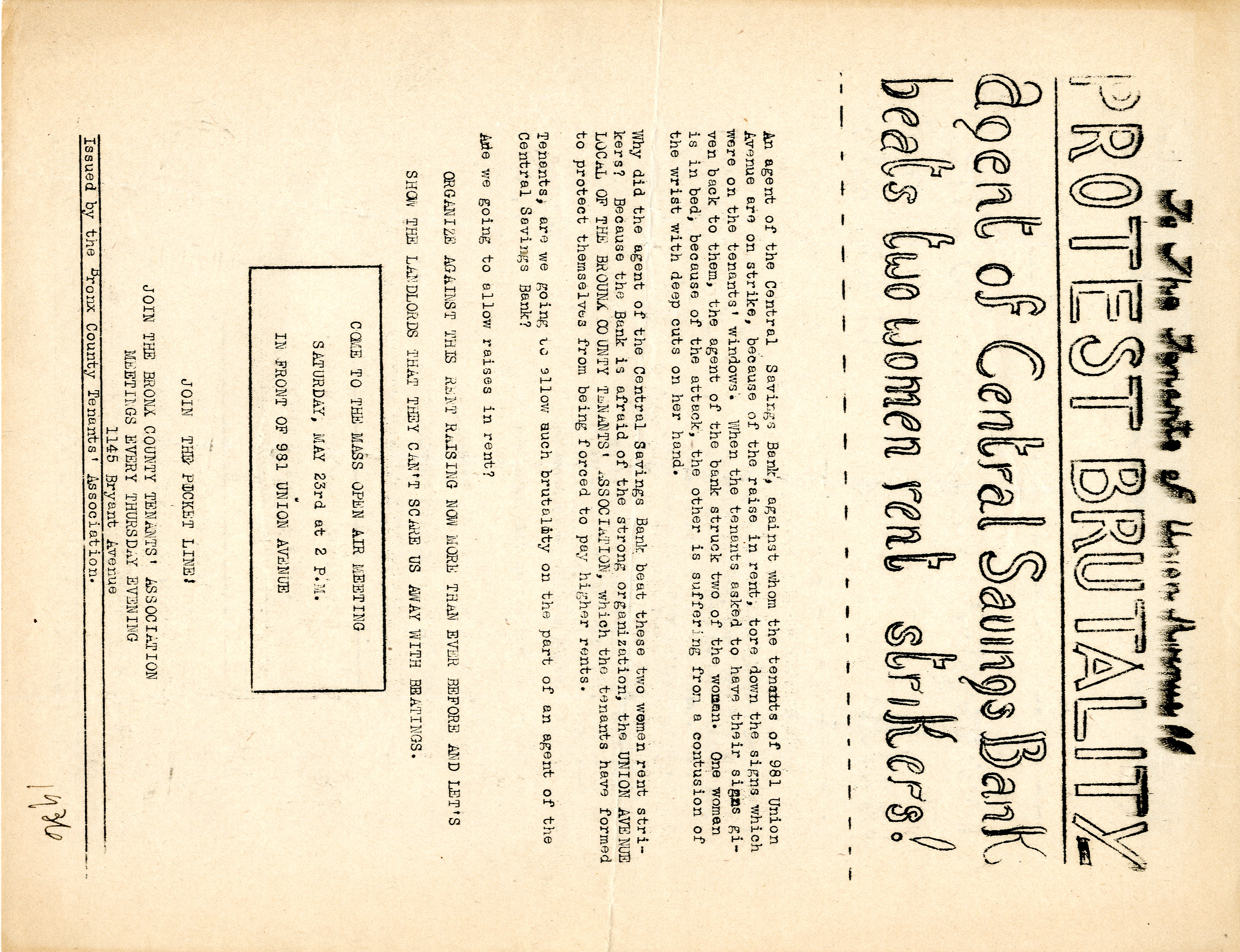
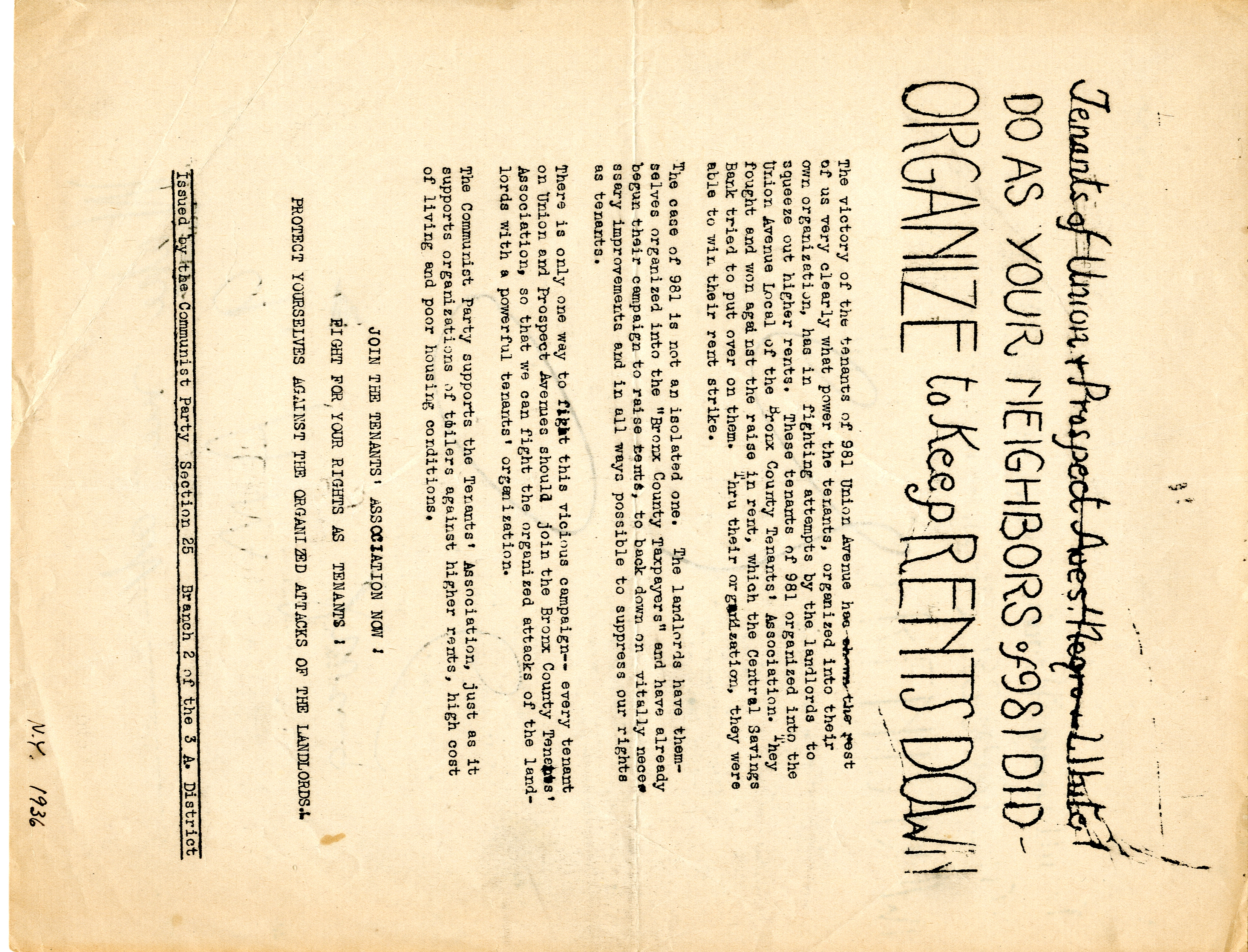
During the Great Depression, tenant groups in New York organized against rent increases and landlord abuses. Original handbills and tenant newspapers reveal how organizers appealed to working-class residents, promoted interracial cooperation, and mobilized communities through public meetings and demonstrations.
The tenant movements of the late 1960s and early 1970s expanded the use of rent strikes and collective bargaining.
The Berkeley Tenants Union and Ann Arbor Tenants Union produced newsletters, organizing handbooks, membership forms, strike pledges, and other materials intended to transform scattered tenant complaints into coordinated campaigns.
These records provide unusually detailed evidence of grassroots organizing methods.
Contemporary accounts demonstrate that rent strikes remain an important organizing strategy.
Tenant campaigns in Kansas City, Chicago, Kentucky, and other communities have sought repairs, rent stability, protection against retaliation, and formal recognition of tenant organizations.
Firsthand testimony emphasizes both the potential achievements and the substantial risks of organized rent resistance.
Some campaigns secure negotiated agreements, while others result in eviction, displacement, prolonged disputes, or continued organizing after residents lose their homes.
The sources therefore present collective bargaining as an ongoing struggle rather than a guaranteed solution.
Women and Immigrant Leadership in Tenant Movements
Women have played central roles in tenant organizing across different historical periods.
Depression-era organizing materials document women's participation in rent strikes, neighborhood meetings, and campaigns against landlord intimidation.
Later oral histories describe women organizing tenants, assisting neighbors in housing court, defending public housing, and managing resident-controlled cooperatives.
Contemporary interviews similarly feature women organizing around mold, unsafe buildings, rent increases, and threats of eviction.
These experiences demonstrate how responsibilities traditionally associated with household maintenance and family security sometimes became foundations for public political activism.
Immigrant communities have also contributed substantially to tenant movements.
Oral histories from Brooklyn and the Bronx document organizing among residents from Latin America and the Caribbean.
Participants describe the importance of bilingual outreach, culturally familiar organizing networks, and assistance for renters who face language barriers or lack knowledge of local housing laws.
Interviews associated with Community Action for Safe Apartments, Neighbors Helping Neighbors, and the Bushwick Housing Independence Project illustrate how immigrant tenant activism developed within broader neighborhood struggles.
Such organizing frequently involved more than individual landlord disputes. Campaigns also addressed displacement, neighborhood redevelopment, discrimination, and the preservation of working-class communities.
Gentrification, Displacement, and Neighborhood Preservation
Tenant organizing has often been closely connected to resistance against displacement.
As property values rise and neighborhoods undergo redevelopment, longtime residents may confront rent increases, landlord harassment, eviction proceedings, and uncertainty about their ability to remain in their communities.
First-person accounts from Sunset Park, Bushwick, and other New York neighborhoods describe how residents experienced these changes.
The narratives document the loss of affordable apartments, changing neighborhood institutions, and the emotional consequences of displacement.
They also reveal how communities developed organizations to challenge redevelopment policies and defend existing residents.
Tenant organizers participated in public hearings, neighborhood coalitions, demonstrations, legal campaigns, and efforts to strengthen rent protections.
Some movements connected housing affordability with environmental justice, arguing that healthy and sustainable neighborhoods should remain accessible to the people who helped build and maintain them.
The experiences of community organizers such as Aura Mejia, Marcela Mitaynes, Elizabeth Yeampierre, and Erica Coca demonstrate how housing campaigns became part of broader struggles over neighborhood identity, political representation, and economic inequality.
Community Land Trusts and Resident-Controlled Housing
Some tenant organizations pursued alternatives to conventional landlord ownership.
Community land trusts, limited-equity housing cooperatives, and other resident-controlled housing arrangements offered mechanisms for preserving affordability and increasing community participation in housing decisions.
Oral histories associated with the Cooper Square Committee and Cooper Square Mutual Housing Association document efforts to protect buildings and residents on Manhattan's Lower East Side.
Participants describe neighborhood organizing, building rehabilitation, resistance to destructive redevelopment, and the creation of institutions intended to maintain affordable housing over long periods.
The Urban Homesteading Assistance Board oral history collection provides additional firsthand accounts of residents who transformed abandoned, deteriorating, or financially troubled properties into cooperative housing.
Residents recount organizing building associations, securing financing, performing renovations, negotiating with government agencies, and learning the responsibilities of collective property management.
These narratives show that resident ownership requires continuing cooperation after the initial campaign succeeds.
Cooperative residents discuss budgeting, maintenance, internal disagreements, leadership succession, and the challenge of preserving affordability as surrounding real estate values increase.
Accounts from several generations of cooperative residents also demonstrate how housing institutions can become centers of neighborhood identity and community continuity.
Homelessness, Direct Action, and Housing Occupations
People experiencing homelessness have also organized collectively to influence housing policy.
The oral histories of Picture the Homeless preserve the experiences of individuals who participated in campaigns for affordable housing, civil rights, and community control over vacant property.
Participants describe shelter conditions, discrimination, housing instability, public demonstrations, and campaigns to make unused buildings available for housing.
These accounts challenge portrayals of people experiencing homelessness solely as recipients of assistance.
Instead, they document individuals organizing meetings, conducting research, developing political demands, recruiting members, and participating in negotiations over housing policy.
Direct-action campaigns sometimes involved building occupations, public sleep-outs, demonstrations, and challenges to policies governing vacant property.
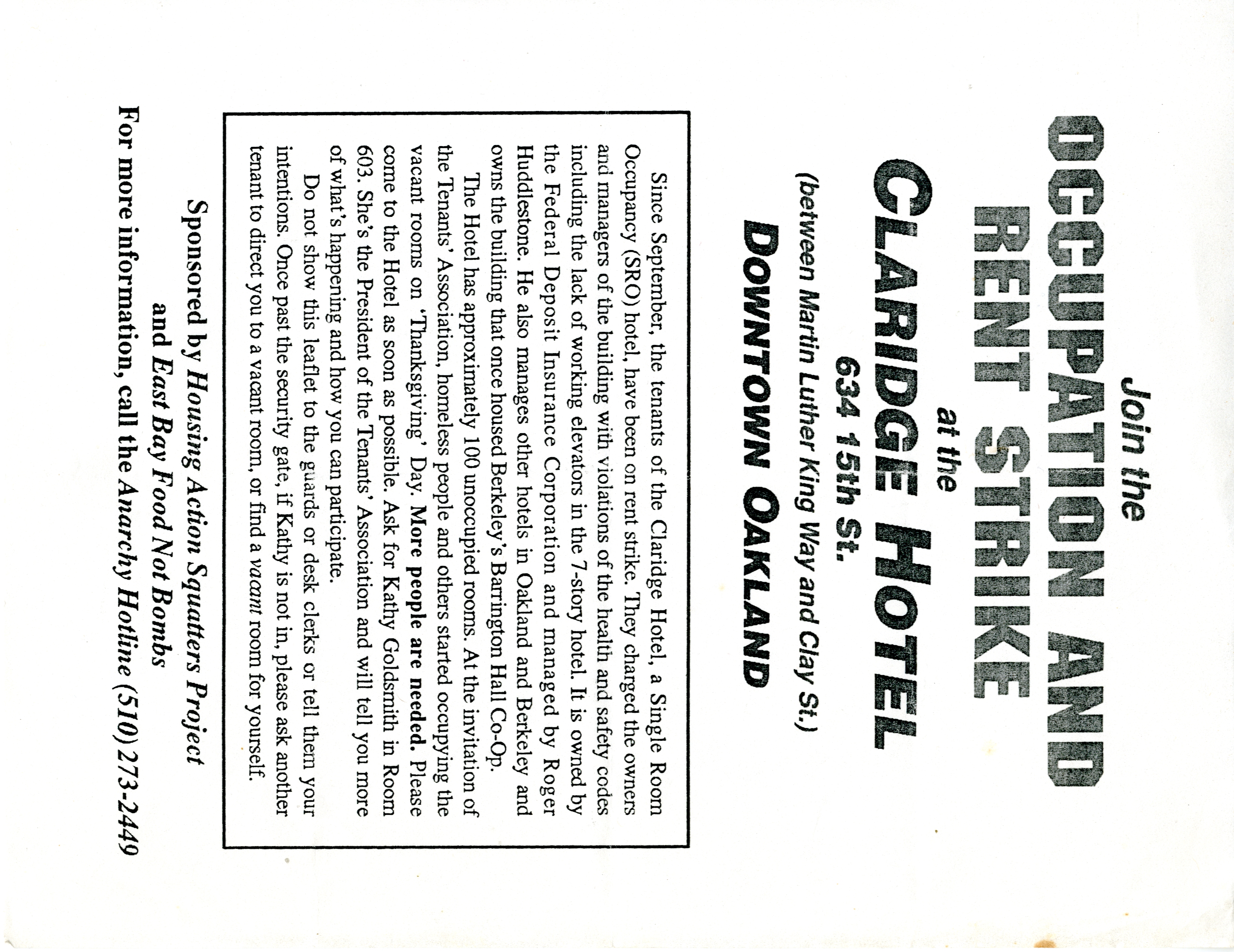
Historical organizing materials from San Francisco and Oakland also document housing occupations and efforts to mobilize communities around homelessness and housing access.
These narratives reveal the relationship between personal housing insecurity and the development of collective political leadership.
They also highlight tensions surrounding property rights, public space, homelessness policy, and the responsibility of government institutions to address unmet housing needs.
Public Housing Residents and Community Advocacy
Public housing residents have organized to address unsafe conditions, inadequate maintenance, insufficient services, and decisions affecting their communities.
Oral histories preserved by the Smithsonian Anacostia Community Museum document residents' experiences with public housing management and neighborhood change.
Participants describe everyday housing conditions while offering perspectives on institutional accountability and the needs of residents.
Other historical collections document campaigns involving public housing rent strikes, tenant associations, and coalitions between residents of different housing developments.
These accounts demonstrate that public housing residents were not simply subjects of government housing policy.
They participated in shaping community priorities, demanding improvements, and organizing collective responses to problems affecting their buildings.
The sources also illustrate how housing activism overlapped with struggles concerning racial discrimination, disability access, poverty, and the availability of essential public services.
Historical Tenant Movements and Community Newspapers
Tenant-produced publications provide an important record of grassroots housing movements.
Unlike official government documents or retrospective historical studies, newsletters, protest flyers, meeting announcements, and organizing handbooks preserve the language and priorities of people participating in campaigns at the time.
The Tenant Archive includes historical materials associated with organizing in New York, Berkeley, Ann Arbor, Philadelphia, New Jersey, Wisconsin, Minnesota, and California.
These sources document campaigns extending from the Depression through the late twentieth century.
Movement publications such as Tenants Rising, Tenant News, and Voice of the Tenant illustrate how organizers circulated information, challenged landlords, and encouraged renters to participate in collective action.
Organizing materials also provide evidence of practical methods, including membership recruitment, neighborhood meetings, rent-strike pledges, tenant education, and public demonstrations.
Community newspapers placed housing conflicts within broader discussions of employment, civil rights, poverty, redevelopment, and political power.
Their preservation helps recover the perspectives of participants whose experiences might otherwise remain absent from conventional historical accounts.
Some surviving records are available only through scanned archive collections. These materials may require examining individual pages to identify authors, publication dates, and the precise circumstances surrounding a campaign.
Contemporary Tenant Unions and Housing Justice Campaigns
Twenty-first-century tenant movements have adapted historical organizing methods to contemporary housing conditions.
Recent firsthand accounts describe organizing against large corporate landlords, rent increases, unsafe building conditions, eviction threats, and restrictions on tenant participation.
Tenant unions have developed campaigns involving building-level associations, coordinated rent strikes, collective bargaining demands, and broader networks of renters.
Interviews with organizers associated with the Los Angeles Tenants Union, Toronto Tenant Union, Living Rent in Scotland, and tenant movements in several American cities demonstrate different approaches to building collective power.
Contemporary campaigns also reveal the importance of organizing among older residents, people with disabilities, immigrant families, and renters facing substantial financial insecurity.
Some firsthand accounts describe successful agreements for building repairs and rent stability.
Others document landlord resistance, intimidation allegations, legal conflicts, and the continuing risk of displacement.
The narratives illustrate how modern tenant organizers combine traditional door-to-door recruitment and neighborhood meetings with broader political campaigns, public communications, and intercity organizing networks.
Although the economic and political conditions have changed, many of the underlying grievances resemble those documented in tenant publications from earlier generations.
Sources and Methods for Recovering Tenant Histories
The collected materials illustrate the value of using different kinds of historical evidence to reconstruct tenant movements.
Oral histories preserve participants' memories of organizing, conflict, leadership, and personal transformation.
Diaries, letters, correspondence, and organizational records can reveal how campaigns developed through everyday interactions.
Community newspapers document contemporary grievances and the political arguments presented by organizers.
Flyers, pledge cards, handbooks, and protest announcements show how movements recruited participants and coordinated activities.
Public testimony provides accounts of housing conditions, landlord practices, and disputes involving government institutions.
Records associated with housing cooperatives and community land trusts document how organizing sometimes resulted in lasting institutions.
Together, these materials provide a more complete historical picture than legislation or official policy records alone.
They also require careful interpretation.
Oral histories may reflect memories recorded many years after events occurred. Organizing publications frequently represent the perspectives of particular movements, while institutional archives may preserve some voices more extensively than others.
Comparing different types of records can help researchers distinguish individual experiences, organizational claims, and documented historical outcomes.
Recurring Themes in First-Person Tenant Narratives
Several themes emerge repeatedly across the collected accounts.
Collective action begins with everyday problems. Many participants describe becoming involved because of poor maintenance, unaffordable rent, eviction threats, or concerns about their families' safety.
Relationships create organizing capacity. Door-to-door conversations, building meetings, and neighbor-to-neighbor assistance frequently provide the foundation for sustained campaigns.
Leadership develops through participation. Residents who initially lacked organizing experience sometimes became association officers, public speakers, negotiators, or community leaders.
Housing struggles intersect with other forms of inequality. Participants connect housing conditions to racism, immigration, disability, environmental hazards, poverty, and political representation.
Campaign outcomes are mixed. Some movements achieve repairs, policy changes, rent protections, or resident ownership, while others confront defeat, displacement, or long-running disputes.
Organizing can create institutions that survive individual campaigns. Tenant unions, community land trusts, housing cooperatives, and neighborhood organizations sometimes preserve collective achievements for future generations.
These recurring experiences connect historical rent strikes with modern tenant unions while revealing the distinctive social and political conditions shaping each movement.
Conclusion
First-person narratives of tenant organizing reveal an important dimension of housing history: the experiences of people who confronted housing insecurity through collective action.
From Depression-era rent strikes to contemporary tenant unions, renters have challenged unsafe conditions, contested displacement, organized across neighborhood and cultural boundaries, and demanded greater influence over the places where they live.
Their accounts demonstrate that tenant movements developed through the efforts of ordinary residents as well as established political organizations.
Women, immigrants, working-class families, public housing residents, cooperative shareholders, and people experiencing homelessness contributed their experiences, relationships, and practical knowledge to these struggles.
The historical record also demonstrates that tenant organizing involves uncertainty, disagreement, personal risk, and the continuing work of maintaining collective institutions.
By preserving oral histories, eyewitness testimony, community publications, organizing documents, and resident-controlled housing records, these sources make it possible to understand housing justice movements from the perspectives of their participants.
Together, they document not only campaigns for affordable and safe housing but also the development of grassroots leadership, democratic participation, and community solidarity.
Bold text== First-Person Narratives: Tenant Organizing — Categorized and Deduplicated Sources ==
Organized by subject. Within each category, links are in reverse chronological order. Identical URLs are consolidated; when an archive index or article contains multiple distinct original entries, those contributors and dates are retained in the summary. Year-only and undated records sort after precisely dated records within the same year.
Contemporary Tenant Unions, Rent Strikes, and Collective Bargaining
1. | Multiple contributors / archival documents | In These Times (shared article) | 2026-08-13
Multiple distinct records share this URL: David Nollman (2026-08-13); Dennis Threatt (2026-08-13). The linked page includes multiple contributors or interviews.
2. | Mario | Black Rose / Rosa Negra | 2026-07-28
An anonymous organizer in the southeastern United States describes helping tenants organize against a nonprofit landlord. His firsthand interview covers neglected maintenance, eviction threats, building meetings, petitions, leadership development, and democratic decision-making.
3. | Multiple contributors / archival documents | The Grind Magazine (shared article) | 2026-06-02
Multiple distinct records share this URL: Beena Ruparelia and Patricia Gorman (2026-06-02); Sasha Mohammed (2026-06-02); Sharlene Henry (2026-06-02); Celeste Crevier (2026-06-02). The linked page includes multiple contributors or interviews.
4. | Espy | Black Rose / Rosa Negra | 2026-05-06
Espy describes organizing a residents' association in a mobile-home park in Utah's Salt Lake Valley. The interview explains door-to-door recruitment, membership agreements, resident voting, bilingual communication, and demands for rent stability and protection from unjust eviction.
5. | Multiple contributors / archival documents | In These Times (shared article) | 2026-04-15
Multiple distinct records share this URL: Heather Myatt (2026-04-15); Maple Grove Tenant Organizers (2026-04-15). The linked page includes multiple contributors or interviews.
6. | Belden Sawyer Tenant Association Members | Shelterforce | 2026-03-27
Chicago tenants recount how their rent strike evolved into a wider campaign for tenant rights. Although they ultimately lost their apartments, participants describe continuing to organize and expanding their association beyond its original building.
7. | Anain | In These Times | 2026-02-19
A South Minneapolis immigrant renter describes the effects of immigration enforcement on her ability to work and pay rent. Her experience provides a firsthand perspective on the conditions that motivated a broader tenant organizing and rent-strike campaign.
8. | Tracy J. Rosenthal | California Digital Library / UC eScholarship | 2026
Los Angeles Tenants Union co-founder Tracy Rosenthal discusses building a citywide tenants' organization, the political geography of Los Angeles, working-class housing struggles, and connections between environmental justice and tenant activism.
9. | Multiple contributors / archival documents | In These Times (shared article) | 2025-12-09
Multiple distinct records share this URL: Cynthia Vega (2025-12-09); April Hedge (2025-12-09); Donna Jackson (2025-12-09). The linked page includes multiple contributors or interviews.
10. | Eilidh | rs21 | 2025-11-09
A member of Scotland's Living Rent tenants union explains how renters organize around landlord harassment, rent increases, repair failures, and community-wide campaigns. Her interview documents the union's organizational structure and methods for building tenant power.
11. | Multiple contributors / archival documents | In These Times (shared article) | 2025-10-02
Multiple distinct records share this URL: Tay'Laur Paige (2025-10-02); Tai'Leah Paige (2025-10-02). The linked page includes multiple contributors or interviews.
12. | E | Black Rose / Rosa Negra | 2025-07-14
A Bay Area organizer identified as E describes organizing with Tenants and Neighborhood Councils. The interview examines building tenant associations, neighborhood campaigns, collective bargaining, and the development of grassroots democratic organizations.
13. | Independence Towers Tenant Union | In These Times | 2025-06-05
Kansas City tenants describe the outcome of a 247-day rent strike that secured an agreement addressing rent stability and long-neglected building repairs. The account documents a significant example of collective tenant bargaining.
14. | Sarah Rooney | Chicago Sun-Times | 2025-05-18
Chicago tenant Sarah Rooney describes participating in a rent strike with the Belden Sawyer Tenant Association. Her testimony explains how belonging to a tenant union helped her resist displacement and gain confidence through collective action.
15. | Anay Herrera | In These Times | 2025-05-16
Anay Herrera recounts more than two decades of family and neighborhood life in Chicago's Buena Park. Her story documents how threatened displacement led longtime residents to organize and coordinate with another tenant union confronting the same property investor.
16. | Ozaa Echo Maker | The Nation | 2024-12-04
Montana renter Ozaa Echo Maker describes her initial reluctance to speak with tenant organizers canvassing her apartment complex. Her experience demonstrates how personal contact and neighborhood relationships can bring previously uninvolved residents into collective organizing.
17. | Tracy Rosenthal and Leo Vilchis | Shelterforce | 2024-10-10
Founders of the Los Angeles Tenants Union describe tenant organizing, rent strikes, and collective bargaining strategies. Their interview offers firsthand reflections on building an independent renters' movement. This is an additional source reference to entry 48 and should be removed during final deduplication.
18. | Multiple contributors / archival documents | In These Times (shared article) | 2024-09-27
Multiple distinct records share this URL: Jorden (2024-09-27); Lolita (2024-09-27). The linked page includes multiple contributors or interviews.
19. | Rose Lenehan and Tara Raghuveer | In These Times | 2024-07-23
Two housing organizers discuss tenant unions as a response to rising rents, evictions, and corporate landlord power. Their movement-authored account incorporates renters' experiences and argues for collective organization rather than isolated legal remedies.
20. | Mike McKee, Interviewed by Karen Ceraso | Shelterforce | 1997-07-01
McKee, a longtime tenant organizer and founder of the New York State Tenants and Neighbors Coalition, recounts the movement's campaign to renew New York rent protection laws. He discusses organizing strategy, coalition politics, and legislative negotiations.
Tenant Associations, Housing Court, and Rent Regulation
21. | Fitzroy Christian | Housing Justice Oral History Project | 2025-04-07
Fitzroy Christian describes organizing a South Bronx tenants' association after his landlord failed to restore cooking gas. His testimony examines collective bargaining, multilingual organizing, rent stabilization, and building solidarity among neighbors.
22. | Fitzroy Christian | Housing Justice Oral History Project | 2025-04-04
Christian recounts his political development from anti-colonial activism in Antigua and Barbuda to organizing tenants in the Bronx. He describes how collective action helped residents confront housing insecurity.
23. | Fitzroy Christian | Housing Justice Oral History Project | 2025
Christian reflects on building citywide and statewide housing coalitions, advocating stronger protections for rent-stabilized apartments, and participating in campaigns contributing to New York's 2019 housing legislation.
24. | Kim Statuto | Housing Justice Oral History Project | 2023-05-26
Statuto recounts discrimination, eviction, family homelessness, and her eventual participation in tenant organizing. She describes how residents formed associations, confronted landlord neglect, and won rent abatements.
25. | Yeraldi Perez | Housing Justice Oral History Project | 2023-04-20
Perez recounts her transition from community member to professional tenant organizer and CASA director. She describes tenant-led press conferences, building organizing, anti-displacement campaigns, and empowering residents to speak publicly about dangerous conditions.
26. | Marilyn Mullins | Housing Justice Oral History Project | 2023-04-18
Mullins explains how tenants organized against deteriorating apartment conditions, took their landlord to court, and obtained repairs. Her testimony emphasizes neighborhood relationships and intergenerational involvement in housing activism.
27. | Mercedes Escoto | Housing Justice Oral History Project | 2023-04-18
Bronx tenant leader Mercedes Escoto describes years of landlord harassment, unsafe housing, rent disputes, and repeated housing court proceedings. She recounts forming a tenants' association with CASA, challenging an unlawful rent increase, and testifying publicly for stronger tenant protections.
28. | Yoselyn Gomez | Housing Justice Oral History Project | 2023-04-17
Gomez describes immigrating from the Dominican Republic, experiencing insecure and unhealthy housing, participating in tenant associations, and becoming a neighborhood advocate for residents facing displacement.
29. | Mildred James | Housing Justice Oral History Project | 2023-04-14
A founding CASA organizer describes door-to-door tenant outreach, bilingual organizing, rent-regulation campaigns, housing court advocacy, and the struggle to guarantee legal representation to tenants facing eviction.
30. | Randy Dillard | Housing Justice Oral History Project | 2023-04-14
Dillard recounts his experiences with housing discrimination, an eviction proceeding, and participation in CASA. He explains how tenant education, solidarity, and grassroots action strengthened his ability to defend housing rights.
Displacement, Gentrification, and Immigrant Tenants
31. | Aura Mejia | Housing Justice Oral History Project | 2024-09-24
Guatemalan-American tenant organizer Aura Mejia describes nearly three decades of housing advocacy in Brooklyn. She recounts witnessing an anti-eviction protest, joining the Fifth Avenue Committee, organizing tenants against poor housing conditions, and resisting development-related displacement.
32. | Fabian Bravo | Housing Justice Oral History Project | 2024-09-24
Mexican immigrant and tenant organizer Fabian Bravo describes his experiences renting in Brooklyn, rising housing costs, landlord harassment, and his involvement with Neighbors Helping Neighbors. His Spanish-language interview documents immigrant tenant organizing in Sunset Park.
33. | Erica Coca | Housing Justice Oral History Project | 2024-03-04
Coca recalls her mother's participation in ACORN, the Fifth Avenue Committee, and the Bushwick Housing Independence Project. Her testimony documents intergenerational tenant activism, campaigns against rent increases, and efforts to preserve affordable housing in Brooklyn.
34. | Margarita Cruz | Housing Justice Oral History Project | 2024-02-12
Mexican immigrant Margarita Cruz describes her experiences in Bushwick, involvement in neighborhood institutions, and development as a community organizer. Her Spanish-language testimony documents immigrant participation in local housing activism.
35. | Amy Collado | Housing Justice Oral History Project | 2024-02-12
Collado recounts her family's displacement, changes in Bushwick's population, and her work rebuilding the Bushwick Housing Independence Project. She discusses tenants facing mold, leaks, landlord neglect, and unaffordable rents, emphasizing leadership development and neighborhood solidarity.
36. | Alberto Mendoza | Housing Justice Oral History Project | 2024
Mendoza describes volunteering with the Bushwick Housing Independence Project, answering calls from tenants, accompanying residents to housing court, and helping families threatened with eviction. His Spanish-language testimony records practical grassroots methods of defending tenants.
37. | Elizabeth Yeampierre | Housing Justice Oral History Project | 2023-10-25
Yeampierre recounts growing up in low-income New York neighborhoods affected by environmental hazards and housing inequality. She describes community organizing through UPROSE, connecting neighborhood preservation, environmental justice, and resistance to displacement.
38. | Marcela Mitaynes | Housing Justice Oral History Project | 2023-08-11
Mitaynes recounts facing eviction from her family's longtime rent-stabilized apartment, an experience that motivated her to become a tenant organizer. She describes working with Neighbors Helping Neighbors, educating tenants about their rights, and building collective political power.
39. | Jeremy Kaplan | Housing Justice Oral History Project | 2023-06-15
Kaplan describes neighborhood campaigns against rent increases, rezoning, gentrification, and displacement in Sunset Park. His testimony documents participation in Protect Sunset Park, Voces Ciudadanas, and other community organizations.
40. | Julia Smith Gould, Edison Gould, and Family | From the Ground Up Oral History Project | n.d.
Family members describe the transformation of East New York and their concerns about rising property values, privatization of public housing, and the possible displacement of longtime residents. Their testimony records community perspectives on development, neighborhood preservation, and housing affordability.
Community Land Trusts, Cooperatives, and Resident Ownership
41. | Brian Rose | Housing Justice Oral History Project | 2025-10-07
Photographer and community organizer Brian Rose recounts joining the Cooper Square Committee on Manhattan's Lower East Side. He describes organizing around building preservation, neighborhood rehabilitation, and resistance to destructive urban renewal policies.
42. | Monxo Lopez | Housing Justice Oral History Project | 2024-10-06
Lopez discusses his involvement in community land trust organizing, neighborhood resistance to unwanted development, and efforts to strengthen democratic community ownership. He reflects on internal conflicts, resident participation, and challenges of transferring leadership to younger generations.
43. | Chris Brandt | Housing Justice Oral History Project | 2024-06-15
Brandt reflects on his experiences in social movements and participation in the Cooper Square Mutual Housing Association and Community Land Trust. His narrative documents resident-controlled housing institutions and the practical challenges of collective governance.
44. | Rob Robinson | Housing Justice Oral History Project | 2023-10-25
Robinson describes his experience with homelessness and subsequent involvement in housing justice advocacy. His oral history connects personal housing insecurity with organizing for housing rights, land justice, and community control.
45. | Ivette de la Cruz | Housing Justice Oral History Project | 2023-02-23
A third-generation Lower East Side housing activist recounts her family's long involvement with the Cooper Square Committee and Mutual Housing Association. She describes growing up among tenant organizers and eventually becoming a community housing leader herself.
46. | Harriet Cohen | Housing Justice Oral History Project | 2022-10-07
Cohen recounts organizing residents facing arson and housing deterioration, working with Adopt-a-Building, and advocating affordable housing. Her testimony explores community campaigns, nonprofit housing development, and protecting displaced residents' access to housing.
Multiple distinct records share this URL: Clarence Grier (2022-07-06); Ryan Duncan (2022-06-27); Anonymous Building Resident (2021-12-08); Kianah Adams, Earline King, and Kayla (2021-11-23); Godfrey Hibbert (2021-11-06); Diane D. Orr (2021-10-21); Anonymous Shareholder (2021-10-15); David Calvert and Stephanie Evans (2021-10-02); Daphne (2021-10-01); Flora Huang (2021-08-23); Josephine Charles (2021-08-21 to 2021-09-08); Theresa Lillian Reid (2021-06-10); Eva (2021-05-21); Mica (2020-09-11); Tauno Biltsted (2019-09-24); Marissa Mack (2019-01-17); Scott and Peter (2018-10-31); Josie Rivera (2018-10-15); David Perez (2018-09-27). The page is a collection index; select the relevant document or interview on the linked page.
48. | HDFC Cooperative Residents | UHAB Cooperative Histories | 2021–2022
A collection of firsthand resident interviews documenting the history of tenant-controlled affordable housing in New York City. Topics include collective renovation, squatting, housing governance, affordability, and the struggle to maintain cooperative ownership.
49. | Tom Angotti | Housing Justice Oral History Project | n.d.
Urban planner and housing activist Tom Angotti reflects on the Cooper Square Community Land Trust and its efforts to preserve affordable housing. He discusses resident participation, internal challenges, and the broader movement for community control of land.
50. | Bushwick Housing Independence Project Tenants and Organizers | Parsons Housing Justice Lab | n.d.
An oral history initiative documenting working-class and immigrant tenants' experiences with gentrification in Bushwick, Brooklyn. Residents and organizers recount housing struggles, collective mobilization, neighborhood coalitions, and campaigns to preserve affordable apartments.
Multiple distinct records share this URL: East Brooklyn Congregations Residents and Organizers (n.d.); Eleanor Pinckney (n.d.); Matilda Dyer (n.d.); Carmen Daniels (n.d.). The linked page includes multiple contributors or interviews.
Homelessness, Direct Action, and Housing Occupations
52. | Lynn Roberts | Housing Justice Oral History Project | 2023-01-06
Roberts recounts her involvement with Picture the Homeless and reflects on coalition building, grassroots organizing, and campaigns for community-controlled housing. Her testimony discusses the development of the community land trust movement.
53. | James Doctor | Housing Justice Oral History Project | 2020-03-05
Doctor recounts joining Picture the Homeless, participating in civil rights campaigns, and attending the Homeless Organizing Academy. His interview explores collective organizing, leadership development, and the experiences of people living with housing insecurity.
54. | DeBoRah Dickerson | Housing Justice Oral History Project | 2020-02-13
Dickerson reflects on the changing Crown Heights neighborhood, community displacement, and her work advocating for people without stable housing. She discusses community land trusts and efforts to create alternatives to speculative real estate development.
55. | Andres Perez | Picture the Homeless Oral History Project | 2019-08-07
Perez describes being priced out of housing, occupying an abandoned city-owned building with friends, and later confronting an apartment landlord over inadequate heating. His testimony follows his involvement in housing organizing, vacant-property campaigns, and collective direct action.
56. | Ryan Hickey | Housing Justice Oral History Project | 2019-05-22
Former housing organizer Ryan Hickey discusses the Housing Not Warehousing Act, community land trusts, vacant-property campaigns, and alternative models of affordable housing. He reflects on organizing across neighborhoods and developing resident-controlled housing institutions.
57. | Tyletha Samuels | Picture the Homeless Oral History Project | 2019-04-19
Samuels recounts her work organizing families experiencing homelessness in New York City. Her testimony addresses shelter campaigns, the Emergency Assistance Unit, rental assistance, and organizing around Section 8 housing vouchers.
58. | Kazembe Balagun | Housing Justice Oral History Project | 2019
Balagun discusses political education, social movements, and community organizing. The interview includes discussion of housing campaign study groups examining cooperative ownership, community land trusts, and strategies for building collective housing power.
59. | Ryan Hickey | Housing Justice Oral History Project | 2019
Hickey recounts his entry into Picture the Homeless and the everyday work of recruiting members, organizing meetings, and developing leadership. He discusses the challenges of sustaining participation and welcoming new organizers into housing campaigns.
60. | Rogers | Housing Justice Oral History Project | 2018-01-18
Rogers describes experiences in the New York shelter system, periods of street homelessness, and joining Picture the Homeless. He recounts participating in housing, civil rights, and Potter's Field campaigns.
61. | Marcus Moore | Housing Justice Oral History Project | 2018-01-11
Moore reflects on participating in the housing and civil rights campaigns of Picture the Homeless. He describes community land trust education, outreach work, board participation, and personal development through collective organizing.
62. | Anthony Williams | Housing Justice Oral History Project | 2018-01-03
Picture the Homeless co-founder Anthony Williams recounts meeting fellow founder Lewis Haggins and developing an organization led by people experiencing homelessness. His firsthand account describes the early development of a grassroots housing movement.
63. | Anthony Williams | Housing Justice Oral History Project | 2018-01-02
Williams recounts growing up in foster care, experiencing institutional insecurity, and developing his commitment to organizing for people without stable housing. The interview provides personal background to his later founding of Picture the Homeless.
64. | Nikita Price | Housing Justice Oral History Project | 2017-12-02
Price recounts joining Picture the Homeless in 2005 and developing into a professional organizer through its training program. He describes organizing around rental assistance, civil rights, and the importance of relationships and respect in grassroots campaigns.
65. | Sam J. Miller | Housing Justice Oral History Project | 2017-11-30
Miller recounts becoming Picture the Homeless's first housing organizer in 2004. He reflects on grassroots leadership, member participation, public communication, and efforts to challenge policies contributing to homelessness and housing inequality.
66. | William Burnett | Housing Justice Oral History Project | 2017-11-16
Burnett discusses joining Picture the Homeless, participating in its housing campaign, and helping develop organizational communications. His interview documents volunteer activism, campaign leadership, and the development of grassroots advocacy networks.
67. | DeBoRah Dickerson | Housing Justice Oral History Project | 2017-10-27
Dickerson describes her experiences in the shelter system and becoming involved in the housing and Women and Families campaigns. She recounts documenting vacant properties in Manhattan and advocating policies that would make unused buildings available for housing.
68. | Arvernetta Henry | Housing Justice Oral History Project | 2017-09-28
Former teacher Arvernetta Henry recalls becoming homeless and joining Picture the Homeless. She describes participating in housing protests, community land trust study groups, outreach, and the movement to establish the East Harlem/El Barrio Community Land Trust.
69. | Maria Walles | Housing Justice Oral History Project | n.d.
Walles describes joining Picture the Homeless, participating in demonstrations and vacant-property actions, and conducting community land trust outreach. She reflects on how organizing helped her gain confidence and participate in public advocacy.
70. | Sue Lob | Picture the Homeless Oral History Project | n.d.
Lob discusses her experiences organizing tenants in New York City, including work building coalitions among residents of public housing developments in Coney Island. She explains how tenants from different developments worked together across racial and neighborhood divisions.
Public Housing Residents and Oral Histories
71. | Jessie Hilliard | Smithsonian Anacostia Community Museum | 2010-08-18
Longtime resident Jessie Hilliard describes conditions at Brooklyn's Marcus Garvey housing development, changes in the neighborhood, and problems with public housing management. Her testimony records residents' perspectives on institutional accountability and community improvement.
72. | Sherri Harden | Smithsonian Anacostia Community Museum | 2010-03-13
Red Hook community organizer Sherri Harden describes advocating for residents confronting public housing problems, inadequate federal housing support, and difficulties obtaining basic services. Her testimony documents neighborhood organizing around housing and community needs.
73. | Lisa Edwards | Smithsonian Anacostia Community Museum | 2010-02-02
Edwards describes living in Brooklyn's Glenmore public housing development and observing its deteriorating conditions. She discusses problems confronting residents and proposes improvements, preserving an everyday resident's perspective on public housing policy.
74. | Public Housing Residents and Oral History Participants | National Public Housing Museum | n.d.
An oral-history-based podcast featuring firsthand accounts of public housing residents across the United States. Episodes use recorded interviews to examine residents' experiences and community life. Some stories provide context for housing justice movements, although the collection is broader than tenant organizing.
Historic Tenant Strikes and Primary-Source Archives
A recorded group oral history examines tenant organizing in East Palo Alto during the early 1980s. Participants discuss the East Palo Alto Council of Tenants, rent stabilization campaigns, the formation of a tenants union, and connections between housing rights and city incorporation.
76. | Multiple contributors / archival documents | Tenant Archive (collection page) | various dates
Multiple distinct records share this URL: Coalition on Homelessness — Golden Gate Park Action: Sleep-Out on Sunday (1995-08-27); Homes for All — Rent Strike and Squat (1995-05-01); Homes Not Jails — Thanksgiving Day Housing Takeover (circa 1990s); Michael Canright — Politicians Won't Solve the Housing Crisis, We Will (1983); Duboce Triangle Committee on Housing — Housing Newsletter (1973-04); Ernie Barry, Editor — The Tenant (in Exile), Issue 4 (1964); San Francisco Community Activists — Dock of the Bay, Volume 1, Number 8 (n.d.); San Francisco Community Activists — Dock of the Bay, Volume 1, Number 13 (n.d.). The page is a collection index; select the relevant document or interview on the linked page.
77. | Claridge Hotel Tenants Association | Join the Occupation and Rent Strike | 1990s
An original flyer announcing a rent strike and building occupation at Oakland's Claridge Hotel. The tenants describe safety-code violations and invite community participation in the struggle.
78. | Multiple contributors / archival documents | Tenant Archive (collection page) | various dates
Multiple distinct records share this URL: 8656 MacArthur Boulevard Tenants Union — March and Rally (1987-03-28); The Flatlands Editorial Collective — No Rent for Rats: Richmond Tenants Battle Landlords (1966-08-27); The Flatlands Editorial Collective — The Flatlands, Volume 1, Number 9 (1966-07-02); The Flatlands Editorial Collective — The Flatlands, Volume 1, Number 3 (1966-04-09). The page is a collection index; select the relevant document or interview on the linked page.
79. | Multiple contributors / archival documents | Tenant Archive (collection page) | various dates
Multiple distinct records share this URL: St. Paul Tenants Union — Tenant News (1980-08); St. Paul Tenants Union — Tenant News (1980-06); Madison Tenant Union — Sick of Being Shit On by Landlords? (circa 1972); Ronald Glotta — Muskegon Rent Strike (1967). The page is a collection index; select the relevant document or interview on the linked page.
80. | Multiple contributors / archival documents | Tenant Archive (collection page) | various dates
Multiple distinct records share this URL: Coalition for Economic Survival — Tenant Housing Campaign Materials (1978-01); Coalition for Economic Survival — Rent Control Campaign Materials (1977-09); Coalition for Economic Survival — Tenants Rights Day (1977-09); Coalition for Economic Survival — Tenant Organizing Publication (1977-07); San Jose Community News — How to Organize a Rent Strike (1977-03); Santa Clara County Tenants Association — Bilingual Tenant Organizing Materials (1970s). The page is a collection index; select the relevant document or interview on the linked page.
81. | Multiple contributors / archival documents | Tenant Archive (collection page) | various dates
Multiple distinct records share this URL: Dwight-Milivia Tenant Association — Tenant Organizing Handbill (1978); Berkeley Tenants Union Number 7 — Tenant Organizing Flyer (1975); Berkeley Tenants Union Number 7 — Berkeley Tenants Union Campaign Publication (1974); Berkeley Tenants Union — Tenants Rising, Volume 1, Number 7 (1970-01); Berkeley Tenants Union — Tenants Rising, Volume 1, Number 8 (1970); Berkeley Tenant Organizers — Organize Unionize (1970s); Berkeley Tenant Organizers — Organize for Control (1970s); Berkeley Tenants Union — Tenant Union Handbook (1970s); Berkeley Tenants Union and Berkeley Public Housing Tenants Association — Joint Tenant Association Flyer (1970s); Berkeley Tenant Organizers — Rent Freeze Coalition Rally (1970s). The page is a collection index; select the relevant document or interview on the linked page.
82. | Multiple contributors / archival documents | Tenant Archive (collection page) | various dates
Multiple distinct records share this URL: Somerville Free Press Editorial Collective — Somerville Free Press (1975-07/08); Massachusetts Community Organizers — Contact (1947); Boston Housing Activists — The Boston Housing Primer, or, By the Hand through Slumlord Land (n.d.). The page is a collection index; select the relevant document or interview on the linked page.
83. | Multiple contributors / archival documents | Tenant Archive (collection page) | various dates
Multiple distinct records share this URL: New Brunswick Tenants Committee — All You Can Eat, Volume 2, Number 7 (1972-02-24); Bishop Towers Tenants Association — Bishop Towers Tenant Organizing Materials (1972); Newark Tenants Organization — Tenant News, Volume 1, Number 5 (1970s); Newark Tenant Organizers — Public Housing Newark Rent Strike (1970s). The page is a collection index; select the relevant document or interview on the linked page.
84. | Multiple contributors / archival documents | Tenant Archive (collection page) | various dates
Multiple distinct records share this URL: Berkeley Tenants Union — Strike Meeting Announcement (circa 1970); Berkeley Tenants Union — Rent Strike Packet (circa 1970); Berkeley Tenants Union Organizers — The Great Berkeley Rent Strike (circa 1970); Berkeley Tenants Union — Tenants vs. America (circa 1970); Berkeley Tenants Union — Collective Bargaining Contract (circa 1970); Berkeley Tenants Union — Rent Strike Pledge Card (circa 1969); Berkeley Tenants Union — Informational Handbill and Sign-Up Form (circa 1969); Berkeley Tenants Union — Join the Tenants Union: Rent Is Theft (circa 1969); Berkeley Tenant Organizers — Tenants Rising, Volume 1, Number 4 (1969); Berkeley Tenant Organizers — Tenants Rising, Volume 1, Number 6 (1969). The page is a collection index; select the relevant document or interview on the linked page.
85. | Multiple contributors / archival documents | Tenant Archive (collection page) | various dates
Multiple distinct records share this URL: Ann Arbor Tenants Union — Tenant Union Newsletter, Volume 2, Number 1 (1970); Ann Arbor Tenant Organizers — Year of the Tenant (circa 1970); Ann Arbor Tenants Union — Tenant Union Newsletter, Issue 4 (1969-08); Ann Arbor Tenant Organizers — Tenant Organizing Handbill (1969-02-06); Ann Arbor Tenant Organizers — Tenant Organizing Handbill (1969-01-22); Ann Arbor Tenant Organizers — Tenant Organizing Handbill (1969-01-13); Ann Arbor Tenant Organizers — Tenant Organizing Handbill (1969-01-08); Ann Arbor Tenant Organizers — Tenant Organizing Handbill (1969-01-04); Ann Arbor Tenants Union — The 1969–1970 Leasing Season Is Approaching (1969); Ann Arbor Tenant Organizers — Know Profits (circa 1969–1970); Ann Arbor Tenant Organizers — Some Data on Rental Living in Ann Arbor (circa 1969–1970). The page is a collection index; select the relevant document or interview on the linked page.
86. | Multiple contributors / archival documents | Tenant Archive (collection page) | 1970s
Multiple distinct records share this URL: Lotta Continua — Housing and Community Organizing Materials (1970s); Italian Housing and Community Activists — Take Over the City (1970s). The page is a collection index; select the relevant document or interview on the linked page.
87. | Powelton Village Tenants Union | The Powelton Village Broadside, Number 1 | 1969-02-05
An original Philadelphia tenant-union newspaper documenting neighborhood organizing. The publication offers direct evidence of how renters communicated political demands and developed local solidarity.
88. | Multiple contributors / archival documents | Tenant Archive (collection page) | various dates
Multiple distinct records share this URL: Mission District Housing Activists — Eric Johnson Arrested: Organizing Documents (circa 1967); Progressive Labor Party — Spark, Volume 1, Number 1 (1965); Progressive Labor Party — Spark, Volume 1, Number 2 (1965); Progressive Labor Party — Spark, Volume 1, Number 3 (1965); Progressive Labor Party — Spark, Volume 1, Number 7 (1965); Mission Tenants Union and Associated Organizers — No Rent for Rats (1960s). The page is a collection index; select the relevant document or interview on the linked page.
89. | New York Tenant Movement Activists and Leaders | NYU Special Collections | 1960s–1980s
The Ronald Lawson Research Files preserve firsthand questionnaires, interviews, correspondence, meeting minutes, and organizing materials produced by New York tenant activists. The collection documents rent strikes, tenant associations, legislative campaigns, and organizing from individual buildings to statewide coalitions.
90. | Multiple contributors / archival documents | Tenant Archive (collection page) | various dates
Multiple distinct records share this URL: Fifth Assembly District Tenant League — Voice of the Tenant, Volume 1, Number 1 (1939); Tenant Organizers — Is Your Landlord a Lawbreaker? (1938); Baker Homes Tenant Campaign — Protest Discrimination at Baker Homes Project (1938); Bronx County Tenants Association — Hunts Point Avenue Tenant Organizing Documents (1937); Bronx County Tenants Association — Tenants Strike Against Rent Raise (1937); Progressive Women's Council — Housewives, We Helped You Before (1936); Bronx County Tenants Association — A Victory for All Tenants (1930s). The page is a collection index; select the relevant document or interview on the linked page.
91. | Bronx County Tenants Association | Protest Brutality Against Women Rent Strikers | 1936
An original tenant-produced flyer protests violence against two women participating in a rent strike at 981 Union Avenue in the Bronx. It describes landlord intimidation and calls residents to a public protest meeting.
92. | Communist Party, New York District | Organize to Keep Rents Down | 1936
An organizing flyer addresses Black and white tenants living near Union and Prospect Avenues. It celebrates the successful rent strike at 981 Union Avenue and encourages residents to unite against rent increases.
93. | Alicia Morales Perez | UCLA Luskin Institute on Inequality and Democracy | n.d.
Morales Perez describes conducting oral history interviews with Los Angeles Tenants Union members during the COVID-19 pandemic. Her methodological account explains how tenant testimony documented housing insecurity, landlord conflicts, and collective resistance during an unprecedented economic crisis.