Why Eugenics Was Once Considered Progressive
Why Eugenics Was Once Considered Progressive
Eugenics is now associated primarily with scientific racism, compulsory sterilization, reproductive coercion, disability discrimination, immigration restriction, and Nazi racial policy. During the late nineteenth and early twentieth centuries, however, many prominent reformers regarded it as a progressive application of science to social problems.
Supporters believed that heredity influenced poverty, illness, intellectual disability, criminality, alcoholism, sexual behavior, and dependence on public assistance. If these conditions were inherited, they reasoned, society could supposedly prevent them by regulating marriage and reproduction. Eugenics therefore appeared to offer a modern and preventive alternative to repeatedly treating social problems after they developed.
The movement attracted scientists, physicians, public-health officials, economists, social workers, educators, feminists, religious leaders, conservationists, and government administrators. Although their motivations varied, they shared confidence in expertise, planning, measurement, and the ability of institutions to improve society. These ideas allowed discriminatory policies to be presented as rational, humane, economical, and socially responsible.
The Progressive Faith in Science
The Progressive Era was marked by confidence that scientific knowledge and professional expertise could replace corruption, tradition, superstition, and inefficient government. Reformers applied measurement and administration to public health, education, housing, labor, agriculture, conservation, and municipal government.
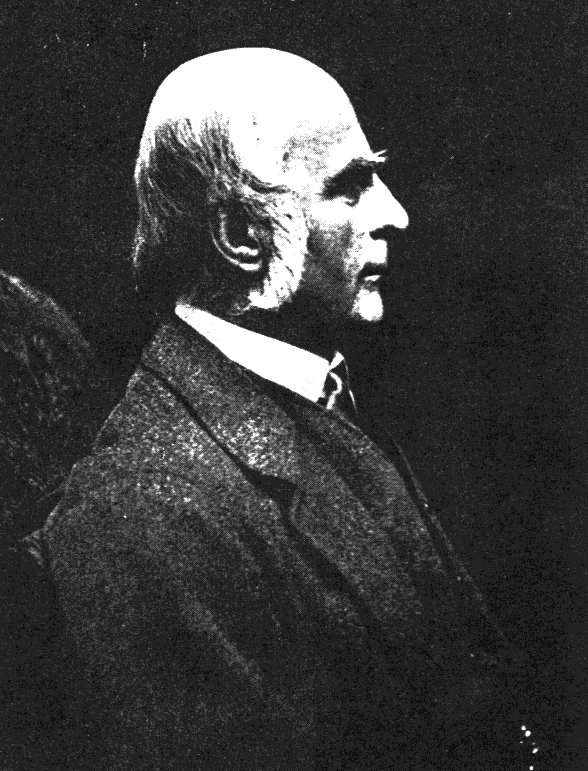
Eugenics developed within this intellectual environment. Francis Galton argued that intellectual ability and social achievement were largely inherited. He introduced the term “eugenics” to describe efforts to improve future generations through selective reproduction. Galton’s reputation as a statistician, explorer, and scientific innovator helped give these proposals credibility.
The rediscovery of Mendelian genetics encouraged advocates to treat complicated human characteristics as if they were controlled by simple hereditary mechanisms. Statistics, family pedigrees, intelligence tests, maps, photographs, and medical examinations gave speculative claims the appearance of objective evidence.
Institutions such as the Eugenics Record Office collected family histories and produced pedigree charts purporting to trace poverty, disability, criminality, and other characteristics through generations. Universities, museums, professional associations, philanthropic foundations, and international conferences further strengthened the movement’s reputation as legitimate science.
Public Health and Preventive Reform
Eugenics appealed strongly to public-health reformers because it used the language of prevention. Public health sought to prevent disease through sanitation, vaccination, nutrition, housing reform, health education, and government regulation. Eugenicists extended this preventive model from infectious and environmental disease to supposedly hereditary social conditions.
Under this reasoning, restricting reproduction was presented as a way to prevent disability, mental illness, poverty, crime, and dependence on institutions. The language of health allowed reproductive control to be portrayed as protection of families, communities, taxpayers, and future generations.
Eugenics overlapped with social-hygiene campaigns against venereal disease, prostitution, alcoholism, and other perceived threats to public morality. It also intersected with maternal and infant health programs, mental-hygiene initiatives, physical-fitness campaigns, and the clean-living movement.
Better Babies and Fitter Families contests brought eugenic ideas into state fairs and community events. Participants were evaluated through medical examinations, intelligence measurements, and family histories. By associating eugenics with healthy infants, responsible motherhood, family improvement, and civic pride, these programs made hereditary judgment appear wholesome and constructive.
Efficiency, Economics, and Social Planning
Efficiency was a central Progressive Era ideal. Reformers sought to make factories, cities, schools, charities, hospitals, prisons, and government agencies more orderly and productive. Eugenicists applied the same philosophy to human populations.
Some economists and welfare officials described people classified as “unfit” as social or financial burdens. Institutionalization, segregation, marriage restrictions, and sterilization were promoted as ways to reduce spending on prisons, hospitals, poor relief, and residential institutions.
Certain progressive economists incorporated eugenic assumptions into arguments concerning immigration, minimum wages, labor regulation, and unemployment. Some believed that a minimum wage would exclude workers considered inefficient or unemployable and might discourage their reproduction. Policies that protected selected workers could therefore coexist with policies that marginalized others.
This reflected a central contradiction in eugenic progressivism. Reformers could support social insurance, workplace protections, public health, and government responsibility while also accepting racial, class, gender, and disability hierarchies. Their concept of collective welfare did not necessarily recognize every person as an equal member of the public.
Immigration, Race, and Nation-Building
Eugenics provided seemingly scientific support for racial hierarchy and immigration restriction. Advocates claimed that nations possessed hereditary qualities that could be strengthened or weakened by migration and reproduction.
Immigrants from Southern and Eastern Europe, people of color, Indigenous communities, and poor families were frequently classified as biologically inferior. Intelligence tests administered to immigrants and military recruits were interpreted as evidence of inherited differences, even though the tests were affected by language, education, culture, and unfamiliar testing conditions.
Eugenic testimony helped support the Immigration Act of 1924, which established national-origins quotas designed to favor immigrants from Northern and Western Europe. Restriction was presented as a means of protecting national health, intelligence, stability, and civilization.
The concept of “race suicide” expressed fears that educated, native-born white families were having fewer children than immigrants, poor families, and racial minorities. Prominent figures encouraged supposedly desirable families to reproduce while demanding restrictions on groups considered undesirable.
This combination of positive and negative eugenics was central to the movement. Positive eugenics encouraged reproduction among people classified as fit, while negative eugenics sought to restrict marriage, immigration, and reproduction among those classified as unfit.
Sterilization as a Supposedly Humane Reform
Compulsory sterilization became one of the most damaging expressions of eugenic policy. Its supporters frequently described it as a humane alternative to lifelong institutionalization. A short medical procedure, they argued, could permit people to leave institutions without allowing them to reproduce.
Indiana enacted the first compulsory eugenic sterilization law in 1907. More than thirty American states eventually adopted sterilization statutes. These programs targeted people labeled intellectually disabled, mentally ill, epileptic, criminal, sexually immoral, dependent, or socially inadequate.
In practice, the classifications were broad, subjective, and deeply influenced by prejudice. Poor people, disabled people, institutionalized individuals, women, racial minorities, Indigenous people, and immigrants were disproportionately targeted.
The United States Supreme Court upheld Virginia’s sterilization law in the 1927 case Buck v. Bell. Carrie Buck was portrayed as a member of a hereditary line of intellectual disability, but the case was constructed through selective and misleading evidence. Her poverty and pregnancy resulting from rape were transformed into supposed proof of inherited moral and intellectual deficiency.
Sterilization programs were administered through hospitals, prisons, welfare agencies, psychiatric institutions, and courts. Bureaucratic procedures allowed coercion to appear routine, objective, and legally responsible.
Women, Feminism, and Birth Control
Some women’s-rights and birth-control advocates adopted eugenic language because it offered scientific and political legitimacy. They argued that voluntary motherhood, access to contraception, maternal health, and women’s independence would improve both individual lives and future generations.
Margaret Sanger and other birth-control advocates sometimes presented contraception as a means of reducing poverty, dependency, illness, and hereditary problems. Although voluntary birth control differed fundamentally from compulsory sterilization, the two movements often occupied overlapping intellectual and institutional networks.
Some feminists believed that giving women greater control over marriage and motherhood would allow them to select healthier partners and produce healthier children. Eugenic feminism could therefore combine demands for women’s emancipation with discriminatory assumptions about race, disability, poverty, and hereditary worth.
Maternalist reformers entered public life by presenting women as guardians of children, homes, communities, and national health. This expanded women’s political influence but also encouraged distinctions between supposedly fit and unfit mothers.
The history demonstrates that reproductive choice can be compromised when public-health or social-welfare goals prioritize population outcomes over the autonomy of individual women.
Disability, Intelligence, and Institutional Power
Eugenics helped transform disability and social difference into evidence of biological inferiority. Terms such as “feeblemindedness” were applied not only to intellectual disability but also to poverty, sexual nonconformity, criminal behavior, poor academic performance, and resistance to authority.
Intelligence testing promised a neutral method for identifying ability. Tests originally developed to determine which students needed educational assistance were transformed into instruments for ranking supposedly innate intelligence. Their results were used to justify segregated schooling, institutionalization, immigration restriction, and sterilization.
Pedigree studies similarly reduced complicated family histories to diagrams of inherited defect. Environmental influences such as poverty, inadequate education, discrimination, trauma, disease, and institutional neglect were often ignored.
Institutions initially presented as places of treatment, education, and protection became centers of confinement and reproductive control. Professional authority allowed decisions about disability and social value to be removed from the people most directly affected.
Disability-rights perspectives challenge the assumption that eliminating disability is necessarily equivalent to social progress. They emphasize autonomy, accessibility, inclusion, support, and the equal worth of disabled lives.
Conservation and Population Improvement
Eugenic thought also overlapped with the early conservation movement. Some influential conservationists used similar language when discussing the preservation of wildlife, natural resources, racial identity, and national strength.
Madison Grant, for example, was both a prominent conservationist and an influential racial theorist. He treated wildlife extinction, racial mixture, immigration, and declining birth rates among selected populations as related threats to biological purity.
Progressive conservation emphasized expert management of forests, water, wildlife, and other resources. For some reformers, human populations appeared to be another resource that could be scientifically classified and managed.
These connections do not mean that conservation was inherently eugenic. They demonstrate, however, how confidence in biological management could cross boundaries between environmental protection and coercive population policy.
Religion and Moral Responsibility
Eugenics was not supported exclusively by secular scientists. Some liberal religious leaders interpreted it as an extension of the Social Gospel and a moral response to poverty, illness, and social suffering.
Religious supporters described hereditary improvement as stewardship of future generations. They believed modern science could help religious communities reduce suffering, strengthen families, and improve society.
Other religious thinkers rejected eugenics. Critics warned that government officials and professional elites could not be trusted to define fitness or decide who should reproduce. G. K. Chesterton argued that vague definitions of hereditary inferiority would give powerful institutions dangerous authority over poor and marginalized people.
Religious responses therefore reflected broader disagreements about science, state power, marriage, human dignity, and the limits of social reform.
Education, Propaganda, and Popular Culture
Eugenics became culturally influential because it was communicated through schools, textbooks, films, museums, newspapers, exhibitions, contests, lectures, and popular literature.
Biology textbooks presented eugenic ideas as accepted scientific knowledge. State-fair exhibits used charts, flashing lights, family trees, and statistical displays to explain the alleged social costs of hereditary defect. The Eugenics Tree symbol suggested that many scientific and professional disciplines supported the movement.
Films such as The Black Stork and Tomorrow’s Children portrayed reproductive control as a difficult but compassionate responsibility. Marriage manuals advised people to consider heredity when selecting partners. Eugenic organizations distributed simplified educational materials designed to make selective reproduction appear understandable and practical.
These campaigns did more than circulate information. They transformed prejudice into a modern visual language of science, health, efficiency, family responsibility, and civic duty.
International Eugenics and the Welfare State
Eugenics was an international movement rather than an exclusively American or German development. It influenced policies and professional debates in Britain, Canada, Scandinavia, Australia, New Zealand, Latin America, Japan, India, and colonial Africa.
Different societies adapted eugenics to their political and cultural circumstances. Some emphasized racial purity and immigration restriction. Others focused on disability, mental health, marriage, birth control, sanitation, maternal welfare, or population planning.
Sterilization programs in countries such as Sweden demonstrate that eugenic coercion could operate within social-democratic welfare states. Officials presented reproductive restrictions as extensions of public health, social adjustment, responsible parenthood, and administrative modernization.
Latin American reformers frequently emphasized sanitation, education, environment, and racial mixture rather than the strictly hereditary models favored by some British and American eugenicists. Nevertheless, these programs could still impose racial, class, gender, and reproductive hierarchies.
Colonial authorities also used eugenic and racial theories to justify segregation, surveillance, population control, and imperial domination as civilizing or modernizing policies.
Why Eugenics Lost Its Progressive Reputation
Eugenics did not disappear because of a single discovery or event. Its reputation declined through scientific criticism, political opposition, exposure of abuses, changing genetic knowledge, and its association with Nazi Germany.
Geneticists increasingly recognized that intelligence, behavior, illness, and social outcomes could not be explained through the simple hereditary models favored by eugenicists. Human characteristics usually result from complicated interactions among many genes, environments, social conditions, and individual experiences.
Anthropologists such as Franz Boas challenged the belief that racial differences were fixed and biologically ranked. Other scientists criticized unreliable pedigree studies, biased intelligence tests, vague diagnoses, and exaggerated claims about inheritance.
Nazi Germany radicalized international eugenic principles through compulsory sterilization, racial legislation, medical killing, persecution, and genocide. German racial hygienists had studied American sterilization statutes and immigration policies, revealing that Nazi eugenics did not develop in complete isolation from other national movements.
The Holocaust and the Nuremberg trials exposed the consequences of subordinating individual rights to collective racial health. Postwar declarations emphasized universal human dignity, informed consent, equality, and protection from medical abuse.
Openly eugenic organizations and publications often changed their names or adopted the language of population studies, human genetics, family planning, and genetic counseling. Although the label became discredited, some underlying assumptions survived.
The Continuing Legacy of Eugenics
The history of eugenics remains relevant because its logic can reappear without the word itself. Eugenic reasoning treats social inequality as primarily biological, ranks lives according to productivity or presumed genetic value, and allows institutions to pursue population goals at the expense of individual rights.
Modern genetics and reproductive medicine create possibilities that early eugenicists could not have imagined. Genetic screening, embryo selection, prenatal testing, gene editing, and assisted reproduction raise difficult ethical questions. These practices are not automatically eugenic, particularly when they support informed and voluntary individual choices.
The danger arises when governments, institutions, markets, or social pressures determine which characteristics and lives are considered desirable. A meaningful distinction must therefore be maintained between personal reproductive autonomy and coercive attempts to shape populations.
The legacy also survives in the experiences of sterilization survivors and communities affected by institutionalization, racialized medicine, disability discrimination, and reproductive injustice. Historical recognition, compensation, archival preservation, and education can help address these harms.
Conclusion
Eugenics was once considered progressive because it adopted the era’s most respected languages: science, prevention, efficiency, expertise, public health, responsible government, and social improvement. Its supporters frequently believed they were reducing suffering and protecting future generations.
Those aspirations were joined to false scientific assumptions and deeply unequal definitions of human worth. By treating poverty, disability, race, sexuality, and social difference as hereditary defects, reformers converted prejudice into policy. Professional authority and bureaucratic procedure then allowed coercion to be represented as compassion.
The history of eugenics demonstrates that policies described as scientific or progressive are not necessarily just. Reform must also be evaluated by how it distributes power, whether it respects individual autonomy, whose knowledge it recognizes, and which communities bear its burdens.
The central lesson is not simply that eugenics was bad science. It is that science and reform can become dangerous when institutions classify some people as obstacles to progress. Genuine social improvement requires equality, informed consent, human rights, and recognition of the inherent value of every person.
Overviews: Eugenics and Progressive Reform
A World History of Eugenics: Biology Is Not Destiny
| Trevor Getz | OER Project | 2026
Places eugenics within a global faith in scientific government, nation-building, modernization, and administrative control of populations.
Eugenics and Scientific Racism
| National Human Genome Research Institute | Genome.gov | 2022
Explains how scientific authority, Mendelian genetics, racism, ableism, colonialism, and reformist optimism combined to make eugenics appear legitimate.
Legacies of Eugenics: Confronting the Past, Forging a Future
| Marius Turda | Ethnic and Racial Studies | 2022
Explores how institutions promoted eugenics as population improvement and how its assumptions survived after the movement lost respectability.
The History and Historiography of Eugenics
| Marius Turda | Springer Nature | 2021
Surveys scholarship showing how eugenics promised modern solutions to poverty, crime, illness, disability, and perceived national decline.
Eugenics: Its Origin and Development
| National Human Genome Research Institute | Genome.gov | 2021
Traces eugenics from Francis Galton through its adoption by respected scientists, reform organizations, governments, and universities.
The Eugenics Movement in Retrospect
| Rob DeSalle | Natural History Magazine | 2021
Reconstructs an era when eminent people and major institutions celebrated eugenics as enlightened scientific progress.
A Brief History of Eugenics in America
| Allen M. Spiegel | Missouri Medicine | 2019
Describes how eugenics became accepted within American science and reform politics before inspiring sterilization and racial legislation.
Reflections on the Historiography of American Eugenics
| Diane B. Paul | Journal of the History of Biology | 2016
Reviews changing interpretations of eugenics and its connections to reform, genetics, professionalization, racism, class, and state power.
America’s Hidden History: The Eugenics Movement
| Laura Rivard | Nature Education | 2014
Introduces the American movement, its prestigious supporters, compulsory sterilization campaigns, and influence on Nazi racial policy.
U.S. Scientists’ Role in the Eugenics Movement
| Steven A. Farber | Zebrafish | 2008
Documents how respected biologists and professional organizations supplied eugenics with scientific authority and institutional credibility.
Eugenics and Economics in the Progressive Era
| Thomas C. Leonard | Journal of Economic Perspectives | 2005
Explains why prominent progressive economists regarded immigration restrictions, minimum wages, and other state interventions as tools for controlling supposedly inferior populations.
The Progressive Origins of Eugenics Critics
| Michael Mezzano | Journal of the Gilded Age and Progressive Era | 2005
Shows that some opposition to eugenics also emerged from progressive intellectual traditions and disputes within genetics.
Eugenics and Progressive-Era Reform
| Thomas C. Leonard | Journal of Economic Perspectives | 2005
Demonstrates that eugenic approaches to economic and social policy were respectable and widespread among American reformers.
Eugenics and Public Health in American History
| Martin S. Pernick | American Journal of Public Health | 1997
Eugenics appealed to reformers because it borrowed the language, methods, and preventive ambitions of the emerging public-health movement.
Eugenics and American Social History, 1880–1950
| Garland E. Allen | Genome | 1989
Shows how reformers embraced eugenics as an efficient, scientific method of attacking the presumed hereditary causes of social problems.
A History of the Eugenics Movement
| Diane B. Paul | Social Research | 1986
Surveys positive and negative eugenics and explains why both attracted supporters who believed society could be scientifically improved.
Eugenics and Progressive Thought
| Michael Freeden | The Historical Journal | 1979
Examines eugenics as an influential strand of British progressive political thought rather than an isolated reactionary doctrine.
Introduction to Eugenics
| Genetic Science Learning Center | Know Genetics | n.d.
Explains how hereditary improvement was presented as a rational means of preventing disease, poverty, dependency, and social disorder.
Why Was Eugenics So Popular?
| Living Archives on Eugenics in Western Canada | Eugenics Archive | n.d.
Examines the social fears, faith in science, and reformist ambitions that helped eugenic ideas enter mainstream public life.
Chapter 19: The Progressive Era—Eugenics
| Teaching American History | Ashbrook Center | n.d.
Presents primary sources showing that eugenics shared progressivism’s emphasis on expertise, rational planning, efficiency, and collective welfare.
Science, Expertise, and Modernity
Francis Galton and the Birth of Eugenics
| Encyclopaedia Britannica Editors | Encyclopaedia Britannica | 2026
Profiles the celebrated statistician whose reputation helped portray selective human breeding as a legitimate scientific project.
The Power of Racial Mapping
| Christina Lavery | Journal of the Gilded Age and Progressive Era | 2022
Shows how maps and geographic expertise lent objectivity to racial hierarchy, immigration restriction, and eugenic intervention.
Human Testing, the Eugenics Movement, and IRBs
| Karen Norrgard | Nature Education | 2008
Connects the prestige of experimental science with abuses committed against people classified as inferior or socially burdensome.
A Decade of Progress in Eugenics
| Scientific Papers of the Third International Congress | Internet Archive | 1934
Reveals how participants explicitly celebrated eugenics as scientific and administrative progress shortly before its association with Nazism intensified.
Essays in Eugenics
| Francis Galton | Eugenics Education Society/Galton.org | 1909
Shows how advocates framed eugenics as civic education, preventive policy, moral responsibility, and service to future generations.
Inquiries into Human Faculty and Its Development
| Francis Galton | Macmillan/Galton.org | 1883
Introduced the word “eugenics” and presented planned heredity as a forward-looking program for human improvement.
Hereditary Genius
| Francis Galton | Macmillan/Galton.org | 1869
Galton’s influential book argued that talent and social eminence were inherited, giving eugenic hierarchy an apparently empirical foundation.
Francis Galton
| Galton.org Editors | Galton.org | n.d.
Provides primary writings and historical materials illustrating Galton’s attempt to establish eugenics as a respected science.
Charles Davenport
| Arizona State University | Embryo Project Encyclopedia | n.d.
Profiles the prominent biologist who transformed eugenics into an organized American research and lobbying enterprise.
Harry Hamilton Laughlin
| Arizona State University | Embryo Project Encyclopedia | n.d.
Describes the influential campaigner who converted speculative hereditarian claims into model sterilization and immigration policies.
The Eugenics Record Office
| Cold Spring Harbor Laboratory | CSHL Archives | n.d.
Documents the research institution that gave eugenic claims the appearance of systematic, objective, and professionally collected knowledge.
Eugenics Record Office
| Wikipedia Contributors | Wikipedia | n.d.
Summarizes the organization’s pedigree studies, fieldworkers, political advocacy, and influence over American public policy.
Eugenics Archive
| Dolan DNA Learning Center | Cold Spring Harbor Laboratory | n.d.
Presents original documents showing how scientific imagery, family pedigrees, exhibits, and statistics popularized eugenic reasoning.
Genetics and Eugenics
| Living Archives on Eugenics | Eugenics Archive | n.d.
Explains how the rediscovery of Mendelian genetics made old social prejudices appear measurable, predictable, and scientifically manageable.
Historical Issues: Grappling with Our Past
| University of Wisconsin–Madison | Department of Genetics | n.d.
Acknowledges how genetics contributed to supposedly scientific rationalizations of racism, sexism, ableism, and eugenics.
Statistics and Eugenics
| University College London | UCL Culture | n.d.
Examines instruments and measurements through which human differences were classified and converted into apparent scientific facts.
Biometrics and Eugenics
| University of York | History of Statistics | n.d.
Illustrates the close historical relationship between statistical innovation, human measurement, hierarchy, and eugenic social planning.
Ellsworth Huntington
| Wikipedia Contributors | Wikipedia | n.d.
Profiles a Yale geographer who linked climate, civilization, racial hierarchy, migration, and eugenic national planning.
The Second International Congress of Eugenics
| American Museum of Natural History | AMNH | n.d.
Examines the museum’s role in a prestigious international gathering that presented eugenics as advanced modern science.
International Eugenics Conferences
| Wikipedia Contributors | Wikipedia | n.d.
Describes global congresses where scientists and public officials exchanged proposals for managing heredity and national populations.
Public Health and Preventive Reform
Progressive Public Health and Medical Enterprise
| Minnesota Historical Society | MNopedia | 2011
Describes the expanding professional infrastructure that made expert-led health and population interventions appear progressive and practical.
The Progressive Era’s Health Reform Movement
| Ruth Clifford Engs | Praeger/Internet Archive | 2003
Connects eugenics with campaigns for sanitation, exercise, pure food, temperance, hygiene, and professional public-health administration.
Eugenics, Medicine, and the “Defective” Baby
| Martin S. Pernick | Oxford University Press | 1996
Examines how physicians and filmmakers framed decisions about disabled infants as scientific compassion, efficiency, and social responsibility.
Maternalism and Eugenics
| Molly Ladd-Taylor | Journal of Women’s History | 1995
Explores how maternal and child-welfare reform could coexist with coercive judgments about which women should reproduce.
Race Betterment Foundation
| Wikipedia Contributors | Wikipedia | n.d.
Describes John Harvey Kellogg’s organization, which combined healthy living, medical reform, temperance, and eugenic population improvement.
John Harvey Kellogg
| Wikipedia Contributors | Wikipedia | n.d.
Shows how an influential physician integrated eugenics with vegetarianism, exercise, public health, sexual regulation, and preventive medicine.
Irving Fisher and Health Reform
| Wikipedia Contributors | Wikipedia | n.d.
Profiles a progressive economist who promoted public health and social insurance while supporting sterilization and positive eugenics.
The Life Extension Institute
| Wikipedia Contributors | Wikipedia | n.d.
Describes a preventive-health organization whose efficiency-oriented philosophy overlapped with eugenic and “race betterment” campaigns.
Social Hygiene Movement
| Wikipedia Contributors | Wikipedia | n.d.
Explains how efforts against venereal disease, prostitution, alcoholism, and mental illness became intertwined with negative eugenics.
Social Purity Movement
| Wikipedia Contributors | Wikipedia | n.d.
Shows how moral reform, feminism, sexual regulation, and eugenics converged around controlling reproduction and protecting the imagined nation.
American Social Hygiene Association
| Social Welfare History Project | Virginia Commonwealth University | n.d.
Describes professional campaigns that linked sexual education and disease prevention with moral surveillance and population management.
Better Babies Contests
| Arizona State University | Embryo Project Encyclopedia | n.d.
Explains how infant-health competitions transformed eugenic judgments into wholesome-looking maternal, medical, and civic improvement programs.
Fitter Family Contests
| Arizona State University | Embryo Project Encyclopedia | n.d.
Describes state-fair competitions that used medical examinations and pedigrees to popularize “good heredity” among ordinary families.
Better Babies and Fitter Families
| Dolan DNA Learning Center | Eugenics Archive | n.d.
Presents photographs and records showing how eugenic propaganda borrowed the friendly imagery of fairs, babies, families, and health education.
The American Baby Health Movement
| National Library of Medicine | NLM | n.d.
Places infant welfare within expanding public-health programs that sometimes treated motherhood and reproduction as matters of national efficiency.
Venereal Disease and Social Hygiene
| National Library of Medicine | NLM | n.d.
Shows how public-health education merged medical prevention with moral judgments about sexuality, fitness, citizenship, and reproduction.
The Clean Living Movement
| Wikipedia Contributors | Wikipedia | n.d.
Describes the reform culture in which exercise, diet, temperance, hygiene, efficiency, and eugenics were presented as mutually reinforcing.
Mental Hygiene Movement
| Wikipedia Contributors | Wikipedia | n.d.
Explains how preventive psychiatry and institutional reform sometimes classified mental difference as hereditary social danger.
Clifford Whittingham Beers
| Wikipedia Contributors | Wikipedia | n.d.
Profiles a mental-health reformer whose era increasingly placed psychological classification within broader programs of scientific social management.
Economics, Efficiency, and the Welfare State
Illiberal Reformers
| Thomas C. Leonard | Princeton University Press | 2016
Shows how progressive economists joined humanitarian reform to exclusionary policies grounded in race science and eugenics.
Illiberal Reformers on JSTOR
| Thomas C. Leonard | Princeton University Press/JSTOR | 2016
Explains how builders of the regulatory welfare state simultaneously advocated uplift for some people and exclusion for others.
Efficiency in Progressive Reform
| Thomas C. Leonard | Princeton University Press/JSTOR | 2016
Describes an era when efficiency connoted morality, organization, expertise, objectivity, and the elimination of perceived social waste.
Valuing Labor
| Thomas C. Leonard | Princeton University Press/JSTOR | 2016
Shows how ostensibly neutral labor analysis incorporated hierarchical assumptions about race, sex, productivity, and hereditary fitness.
Darwinism in Economic Reform
| Thomas C. Leonard | Princeton University Press/JSTOR | 2016
Examines how progressive economists translated evolutionary ideas into arguments for state classification and labor-market control.
The Progressive Case for Regulating Women’s Work
| Thomas C. Leonard | Yale Journal on Regulation | 2005
Demonstrates how protective labor laws were defended partly through maternalist, racial, and eugenic conceptions of women’s social role.
Minimum Wages and Eugenics
| Thomas C. Leonard | Princeton University | 2005
Explains how some economists expected minimum wages to identify, exclude, or discourage the reproduction of workers deemed unemployable.
Race, Eugenics, and American Economics
| Thomas C. Leonard | Cambridge University Press | 2005
Places eugenic thinking inside mainstream academic economics, labor regulation, immigration policy, and administrative reform.
The Social Gospel and Eugenics
| Christine Rosen | Oxford University Press | 2004
Shows how religious reformers could interpret eugenics as responsible stewardship, charity reform, and service to future generations.
Preaching Eugenics
| Christine Rosen | Oxford University Press | 2004
Documents the support eugenics received from liberal clergy seeking scientifically informed solutions to social suffering.
The Cost of “Defectives”
| Harry H. Laughlin | Internet Archive | 1922
Shows how sterilization advocates used economic calculations to recast coercion as prudent, preventive, taxpayer-conscious reform.
Eugenics, Euthenics, and Eudemics
| Lester F. Ward | American Journal of Sociology/Internet Archive | 1913
Presents an early sociological challenge to hereditarian reform by emphasizing education, environment, and social conditions.
The Kallikak Family
| Henry H. Goddard | Classics in the History of Psychology | 1912
An influential and deeply flawed study that made poverty and disability appear traceable through a simple hereditary pedigree.
The Economic Cost of the “Unfit”
| Dolan DNA Learning Center | Eugenics Archive | n.d.
Presents propaganda claiming sterilization and segregation would reduce taxation, institutional costs, crime, poverty, and dependency.
Institutionalization
| Living Archives on Eugenics | Eugenics Archive | n.d.
Explains how confinement was promoted as humane care, fiscal efficiency, social protection, and prevention of supposedly hereditary reproduction.
Sexual Segregation
| Living Archives on Eugenics | Eugenics Archive | n.d.
Describes proposals to separate institutionalized men and women as a less visibly violent alternative to compulsory sterilization.
Charity Organization and Heredity
| Social Welfare History Project | Virginia Commonwealth University | n.d.
Provides context for reformers’ distinction between the allegedly deserving poor and families regarded as chronically dependent or defective.
The Jukes Family Study
| Wikipedia Contributors | Wikipedia | n.d.
Explains how a family case study was used to portray poverty, criminality, and dependency as inherited burdens on taxpayers.
The Kallikak Family and Eugenic Propaganda
| Wikipedia Contributors | Wikipedia | n.d.
Describes how staged photographs and manipulated family history gave eugenic claims a misleading appearance of scientific proof.
Euthenics and Social Improvement
| Wikipedia Contributors | Wikipedia | n.d.
Describes a competing reform philosophy that emphasized improving environments rather than preventing the reproduction of particular people.
Immigration, Race, and Nation-Building
Intelligence Testing and Immigration
| Ludy T. Benjamin Jr. | American Psychological Association | 2009
Examines how early mental testing reinforced claims that immigrants and minority populations possessed inferior intelligence.
Herbert Spencer Jennings and the 1924 Immigration Act
| Elazar Barkan | Journal of American History | 1991
Examines scientific conflict over racial heredity during the political campaign for immigration restriction.
A Study of American Intelligence
| Carl C. Brigham | Princeton University Press/Internet Archive | 1923
Shows how questionable test data were used to defend immigration quotas and warn against national genetic decline.
The Rising Tide of Color
| Lothrop Stoddard | Internet Archive | 1920
Demonstrates how demographic alarm, imperial anxiety, and hereditarian racism were framed as objective geopolitical analysis.
The Passing of the Great Race
| Madison Grant | Internet Archive | 1916
An influential example of how racial hierarchy and immigration restriction were packaged as scientific conservation of the nation.
Theodore Roosevelt and Race Suicide
| Theodore Roosevelt | Theodore Roosevelt Center | 1905
Illustrates how pronatalism among selected families was described as patriotic duty and protection of national civilization.
Eugenics and the Immigration Act of 1924
| National Human Genome Research Institute | Genome.gov | n.d.
Explains how supposedly scientific racial rankings helped justify restrictive national-origins quotas.
Madison Grant
| National Park Service | NPS | n.d.
Profiles a conservationist and racial theorist who joined environmental preservation to immigration restriction and white supremacy.
Lothrop Stoddard
| Wikipedia Contributors | Wikipedia | n.d.
Profiles a prominent writer who popularized racial fears and presented global white supremacy as a problem of population science.
Race Suicide
| Wikipedia Contributors | Wikipedia | n.d.
Explains the fear that educated white families were being out-reproduced by immigrants, poor people, and racial minorities.
Theodore Roosevelt and Eugenics
| National Human Genome Research Institute | Genome.gov | n.d.
Documents Roosevelt’s endorsement of encouraging reproduction among people whom reformers considered socially desirable.
Woodrow Wilson and Compulsory Sterilization
| New Jersey State Archives | State of New Jersey | n.d.
Provides context for Wilson’s approval of a New Jersey sterilization measure later invalidated by the courts.
The Dillingham Commission
| Stanford University Libraries | Stanford University | n.d.
Describes a massive federal investigation that helped represent immigration restriction as data-driven administrative policy.
Army Intelligence Tests
| Wikipedia Contributors | Wikipedia | n.d.
Describes mass testing presented as modern scientific administration but later used to support racial and immigration hierarchies.
Carl Brigham and American Intelligence
| Wikipedia Contributors | Wikipedia | n.d.
Profiles the psychologist whose interpretation of military tests promoted hereditary explanations for ethnic differences.
Educational Testing
| Living Archives on Eugenics | Eugenics Archive | n.d.
Explains how standardized testing promised objective merit while reproducing eugenic classifications of intelligence and fitness.
The Immigration Act of 1924
| Office of the Historian | U.S. Department of State | n.d.
Explains the national-origins quota system shaped by nativism, racial hierarchy, and contemporary eugenic testimony.
The Johnson-Reed Act
| National Archives | U.S. National Archives | n.d.
Presents the legislation through which racialized population management became established federal immigration policy.
Eugenics and American Nation-Building
| Library of Congress | LOC | n.d.
Provides historical sources connecting immigration control, citizenship, racial classification, and ideas about hereditary national fitness.
Sterilization as “Humane” Reform
Eugenic Sterilization in Virginia
| Gregory Michael Dorr | Encyclopedia Virginia | 2023
Documents how Virginia combined public health, welfare administration, segregation, and hereditary ideology.
Unfit to Breed: America’s Dark Tale of Eugenics
| Allen M. Spiegel | NIH Catalyst | 2021
Shows how elite sponsorship and scientific respectability normalized compulsory sterilization as responsible reform.
Buck v. Bell: The Test Case for Virginia’s Eugenical Sterilization Act
| Gregory Michael Dorr | Encyclopedia Virginia | 2021
Explains how officials deliberately constructed a legal case intended to validate sterilization as progressive social policy.
Forced Sterilization Programs in the United States
| Lisa Ko | PBS Independent Lens | 2016
Surveys programs that targeted poor, disabled, Indigenous, Black, Latina, and institutionalized people under the language of social welfare.
The Forgotten Lessons of the American Eugenics Movement
| Andrea DenHoed | The New Yorker | 2016
Recounts how lawyers, physicians, and judges constructed Carrie Buck’s sterilization as a test of enlightened public policy.
California’s Sterilization Survivors
| PBS Independent Lens | PBS | 2016
Connects eugenic history with later coercive sterilizations of Mexican-origin women in California hospitals.
Three Generations, No Imbeciles
| Paul A. Lombardo | Internet Archive | 2008
Demonstrates that Buck v. Bell resulted from institutional ambition, prejudice, selective evidence, and a coordinated reform campaign.
Eugenics in Indiana
| Alexandra Minna Stern | Indiana University | 2007
Places Indiana’s sterilization program within Progressive Era medicine, prison reform, public welfare, and scientific administration.
Sterilized in the Name of Public Health
| Alexandra Minna Stern | American Journal of Public Health | 2005
Shows how California framed sterilization as preventive medicine and efficient management of institutions and families.
Skinner v. Oklahoma
| U.S. Supreme Court | Justia | 1942
The ruling limited punitive sterilization while leaving the earlier constitutional approval of eugenic sterilization formally intact.
Buck v. Bell
| U.S. Supreme Court | Justia | 1927
The decision that constitutionalized compulsory sterilization by placing asserted collective welfare above reproductive autonomy.
Eugenic Sterilization Laws
| Paul A. Lombardo | Eugenics Archive | n.d.
Explains how sterilization was promoted as a modern, inexpensive, and supposedly humane alternative to lifelong institutionalization.
Carrie Buck
| Encyclopedia Virginia | Virginia Humanities | n.d.
Restores the life of the woman whose poverty and pregnancy from rape were falsely presented as proof of hereditary unfitness.
Indiana’s 1907 Eugenics Law
| Indiana Historical Bureau | State of Indiana | n.d.
Explains why Indiana became the first jurisdiction in the world to enact a compulsory eugenic sterilization law.
California’s Eugenic Sterilization Program
| Lutz Kaelber | University of Vermont | n.d.
Summarizes the nation’s largest sterilization program and the institutional logic used to justify it.
North Carolina Eugenics Board
| NCPedia Editors | NCPedia | n.d.
Describes a program in which welfare officials initiated sterilizations based on poverty, disability, sexuality, and family circumstances.
North Carolina Justice for Sterilization Victims Foundation
| North Carolina Department of Natural and Cultural Resources | NC Digital Collections | n.d.
Provides records showing how bureaucratic procedures transformed prejudice into routine welfare policy.
Eugenics in Washington State
| University of Washington | Disability Studies | n.d.
Collects laws, cases, and scholarship revealing the participation of courts, prisons, universities, and medical professionals.
Oregon’s Eugenics History
| Michael McGregor | Oregon Encyclopedia | n.d.
Explains how Oregon’s sterilization board operated through the language of health, protection, rehabilitation, and fiscal responsibility.
The Iowa Board of Eugenics
| Annals of Iowa | University of Iowa | n.d.
Examines how public officials institutionalized reproductive control as part of modern state governance.
Women, Feminism, and Birth Control
Women, Sterilization, and the Politics of Choice
| Erika Dyck | University of Toronto Press | 2013
Examines the unstable boundary between voluntary reproductive reform and coercive state control in Canada.
Charlotte Perkins Gilman and Eugenics
| Laura L. Lovett | American Quarterly | 2000
Examines how feminist visions of women’s independence and socialized motherhood could coexist with racial and eugenic nationalism.
The Pivot of Civilization
| Margaret Sanger | Project Gutenberg | 1922
Shows Sanger using eugenic and economic arguments to present contraception as a remedy for poverty and social dependency.
The Eugenic Value of Birth Control Propaganda
| Margaret Sanger | NYU Margaret Sanger Papers Project | 1921
A primary document demonstrating how birth-control campaigning was explicitly presented as complementary to eugenic objectives.
Woman and the New Race
| Margaret Sanger | Project Gutenberg | 1920
Illustrates how birth control was promoted simultaneously as women’s emancipation, social progress, and hereditary improvement.
Radiant Motherhood
| Marie Stopes | Internet Archive | 1920
Demonstrates how maternal health and planned parenthood could be linked to judgments about hereditary worth.
Birth Control Review
| Margaret Sanger and Contributors | University of Pennsylvania | 1917–1940
A primary-source collection showing how reproductive freedom, maternal health, population control, and eugenics shared intellectual space.
Herland
| Charlotte Perkins Gilman | Project Gutenberg | 1915
A feminist utopian novel whose planned motherhood and collective child-rearing also reflect contemporary eugenic assumptions.
Women and Economics
| Charlotte Perkins Gilman | Project Gutenberg | 1898
Advocates women’s economic independence while illustrating the evolutionary and social-efficiency language common to progressive reform.
Eugenics and Birth Control
| PBS American Experience | PBS | n.d.
Explains how birth-control advocates borrowed eugenic language to obtain legitimacy from scientists, physicians, philanthropists, and policymakers.
Margaret Sanger and Eugenics
| Margaret Sanger Papers Project | New York University | n.d.
Provides historical context for Sanger’s strategic alliance with eugenicists and her distinction between voluntary and coercive policies.
Marie Stopes and Eugenics
| Wellcome Collection | Wellcome | n.d.
Explores how a pioneering British contraception advocate combined sexual reform and women’s health with discriminatory hereditary ideas.
Victoria Woodhull and Stirpiculture
| Wikipedia Contributors | Wikipedia | n.d.
Describes an early American theory of planned human reproduction that linked sexual reform with hereditary improvement.
Eugenics and Women’s Reform Organizations
| National Park Service | NPS | n.d.
Explains how clubwomen connected eugenics with maternal education, child welfare, sanitation, and civic housekeeping.
The National Federation of Women’s Clubs and Eugenics
| Library of Congress | LOC | n.d.
Provides context for women’s organizations that helped bring hereditary improvement campaigns into community reform.
Maternalism
| Wikipedia Contributors | Wikipedia | n.d.
Explains the ideology that justified women’s public activism through motherhood while distinguishing between supposedly fit and unfit mothers.
Eugenic Feminism
| Wikipedia Contributors | Wikipedia | n.d.
Surveys feminists who believed women’s emancipation and reproductive selection would jointly improve future society.
Reproductive Rights and Eugenics
| ACLU | American Civil Liberties Union | n.d.
Shows how progressive-sounding medical and welfare programs disproportionately deprived marginalized women of reproductive autonomy.
Disability, Intelligence, and Institutional Power
Defective or Disabled?
| Gregory Michael Dorr | Journal of the Gilded Age and Progressive Era | 2006
Examines how race and regional medical politics shaped definitions of disability and support for sterilization.
Disability and Eugenics
| Marsha Saxton | Disability Studies Quarterly | 2006
Interprets eugenics from a disability-rights perspective and challenges assumptions that preventing disability necessarily constitutes progress.
The Invention of Feeblemindedness
| James W. Trent Jr. | University of California Press/JSTOR | 1994
Shows how professionals constructed a broad diagnostic category that justified segregation, institutionalization, and sterilization.
The Measurement of Intelligence
| Lewis M. Terman | Internet Archive | 1916
Demonstrates how standardized testing was presented as objective expertise capable of directing education, employment, and reproduction.
Mental Deficiency Act 1913
| Parliament of the United Kingdom | UK Legislation | 1913
Demonstrates how British administrators converted classifications of mental deficiency into a national system of detention and supervision.
Henry H. Goddard
| Arizona State University | Embryo Project Encyclopedia | n.d.
Profiles the psychologist who popularized intelligence testing and hereditary interpretations of intellectual disability.
The Binet-Simon Intelligence Scale
| Wikipedia Contributors | Wikipedia | n.d.
Describes a testing instrument transformed from an educational aid into a tool for ranking purported innate intelligence.
Lewis Terman
| Wikipedia Contributors | Wikipedia | n.d.
Profiles a progressive educator who promoted intelligence testing, gifted education, and eugenic interpretations of mental ability.
Walter Fernald
| Wikipedia Contributors | Wikipedia | n.d.
Profiles an institutional reformer whose early humanitarian work evolved into support for segregation and eugenic control.
The Fernald School
| National Park Service | NPS | n.d.
Explains how a reform institution became a site of confinement, classification, experimentation, and reproductive control.
The Vineland Training School
| Wikipedia Contributors | Wikipedia | n.d.
Describes a leading center for psychological testing, institutional care, and eugenic research.
Pedigree Studies
| Dolan DNA Learning Center | Eugenics Archive | n.d.
Shows how family charts reduced complex social conditions to visual patterns of allegedly inherited defect.
Feeblemindedness
| Living Archives on Eugenics | Eugenics Archive | n.d.
Explains how an elastic diagnosis absorbed intellectual disability, poverty, sexuality, criminality, and nonconformity.
The Ugly Laws
| Wikipedia Contributors | Wikipedia | n.d.
Describes municipal laws that excluded visibly disabled people from public spaces under ideals of order, beauty, and civic improvement.
Institutionalization and Progressive Reform
| Social Welfare History Project | Virginia Commonwealth University | n.d.
Provides background on institutions presented as treatment and protection but frequently used for segregation and social control.
The Mental Deficiency Act and Eugenics
| Open University | OpenLearn | n.d.
Explains how institutional care, social protection, and fear of hereditary degeneration reinforced one another.
Speech-Language Pathology and Eugenics
| Living Archives on Eugenics | Eugenics Archive | n.d.
Traces how professional judgments about communication and normality developed within a wider culture of classification and correction.
Deafness and Eugenics
| Gallaudet University | History Through Deaf Eyes | n.d.
Examines attempts to prevent deaf intermarriage and how Deaf communities resisted being classified as biologically unfit.
Eugenics and Disability History
| Disability History Museum | Straight Ahead Pictures | n.d.
Provides primary sources illustrating how welfare, medicine, education, and eugenics defined whose lives were socially valuable.
Conservation, Environment, and Racial Improvement
The Conservation Movement’s Eugenics Problem
| Michael Brune | Sierra Club | 2020
Discusses racism and exclusion within conservation history, including connections among wilderness protection, hierarchy, and social purity.
Eugenics and the American Environmental Movement
| Garland E. Allen | Journal of the History of Biology | 2013
Examines intellectual links between biological conservation, population control, heredity, and racial nationalism.
Save the Redwoods and Eugenics
| Save the Redwoods League | Save the Redwoods League | n.d.
Confronts the racial ideology of an important conservationist and cofounder of the organization.
The Boone and Crockett Club
| National Park Service | NPS | n.d.
Provides context for elite networks in which wildlife conservation and racial preservation overlapped.
Scientific Forestry and Social Planning
| Forest History Society | Forest History Society | n.d.
Explains the Progressive Era belief that trained experts could rationally manage forests, resources, cities, and human populations.
The Country Life Movement
| Wikipedia Contributors | Wikipedia | n.d.
Describes a rural reform campaign concerned with efficiency, health, family life, and fears of declining native-born populations.
Theodore Roosevelt, Conservation, and Race
| Theodore Roosevelt Center | Dickinson State University | n.d.
Provides primary materials showing how conservation, strenuous citizenship, pronatalism, and national strength could share a common vocabulary.
Religion, Morality, and Social Reform
Religion and the American Eugenics Movement
| Pew Research Center | Pew Research Center | 2004
Summarizes how clergy helped translate hereditary improvement into the language of stewardship, family responsibility, and social salvation.
Liberal Religion and Hereditary Reform
| Christine Rosen | Oxford Academic | 2004
Explains how modernist religious leaders reconciled faith with scientific claims about human improvement.
The Catholic Church and Eugenics
| | Pope Pius XI | Vatican | 1930
Presents a major religious rejection of compulsory sterilization and state interference with marriage and reproduction.
Eugenics and Other Evils
| G. K. Chesterton | Project Gutenberg | 1922
An important contemporary critique warning that state-directed breeding would empower elites to control the poor.
The Social Gospel
| Wikipedia Contributors | Wikipedia | n.d.
Provides context for a movement that sought systemic solutions to poverty and sometimes welcomed scientific population reform.
Washington Gladden
| Wikipedia Contributors | Wikipedia | n.d.
Profiles a Social Gospel leader active during the period when religious reform and professional social science became closely connected.
Walter Rauschenbusch
| Wikipedia Contributors | Wikipedia | n.d.
Represents progressive Christianity’s effort to transform social institutions rather than restrict moral responsibility to individuals.
The Eugenics Education Society
| Eugenics Education Society | Wellcome Collection | n.d.
Preserves material from an organization that sought to turn eugenics into respectable public education and social policy.
Education, Propaganda, and Popular Culture
Eugenics in High School History
| Timothy F. Cargill | The History Teacher | 2020
Examines how eugenics can be taught as a mainstream American movement rather than merely a prelude to Nazi Germany.
Eugenics Propaganda
| Eugenics Review Contributors | Wellcome Trust/PMC | 1938
Provides contemporary discussion of techniques used to persuade the public that hereditary control was civic education.
Tomorrow’s Children
| Bryan Foy | Internet Archive | 1934
A film presenting sterilization as a tragic but necessary intervention by benevolent medical authorities.
Eugenics Catechism
| Paul Popenoe | Internet Archive | 1926
Shows how activists reduced eugenics to simple questions and answers designed for popular instruction.
Are You Fit to Marry?
| Medical Film | Internet Archive | 1919
Illustrates how marriage advice, public health, and eugenic screening were combined in popular education.
Applied Eugenics
| Paul Popenoe and Roswell Hill Johnson | Project Gutenberg | 1918
A textbook that integrated heredity, marriage, immigration, education, sterilization, and social policy.
Eugenical News
| Eugenics Record Office | Internet Archive | 1916–1953
A primary-source periodical showing the movement’s international networks, policy priorities, and claims to scientific progress.
A Civic Biology
| George William Hunter | American Book Company/Internet Archive | 1914
A widely used textbook that presented racial hierarchy and eugenic social policy as accepted biological knowledge.
The Science of Human Improvement by Better Breeding
| Charles B. Davenport | Internet Archive | 1910
A concise primary text presenting selective reproduction as practical science and a responsibility to posterity.
The Eugenics Review
| Eugenics Education Society | PubMed Central | 1909–1968
Provides decades of primary material charting eugenics from confident reform science to postwar rebranding.
The Scopes Trial and Eugenics
| Facing History & Ourselves | Facing History | n.d.
Shows that the biology textbook at the center of the trial taught both evolution and coercive eugenic ideas.
Popular Culture and Eugenics
| Living Archives on Eugenics | Eugenics Archive | n.d.
Surveys novels, films, fairs, posters, radio, and journalism that normalized or criticized eugenic ideas.
The Black Stork
| Wikipedia Contributors | Wikipedia | n.d.
Describes a film that dramatized the refusal of treatment to disabled newborns as courageous medical and social reform.
Paul Popenoe
| Wikipedia Contributors | Wikipedia | n.d.
Profiles an advocate who moved from sterilization campaigns into marriage counseling, carrying eugenic assumptions into family reform.
The Eugenics Tree
| National Human Genome Research Institute | Genome.gov | n.d.
Explains the movement’s famous symbol, which claimed eugenics drew nourishment from many sciences and reform disciplines.
The American Eugenics Society
| Wikipedia Contributors | Wikipedia | n.d.
Describes the organization’s public lectures, exhibits, contests, publications, and alliances with established professionals.
Eugenics Quarterly
| Wikipedia Contributors | Wikipedia | n.d.
Traces the transformation of an openly eugenic journal into one using the less stigmatized language of social biology.
International Eugenics and Social Democracy
Eugenics in Australia
| Ross L. Jones | The Conversation | 2020
Examines how Australian academics and reformers connected public health, racial nationalism, disability, and population improvement.
Eugenics in Japan
| The Japan Times | The Japan Times | 2019
Describes sterilizations carried out under legislation promoted as protection, public welfare, and national genetic health.
Japan’s Eugenic Protection Law
| Sayuri Umeda | Library of Congress | 2019
Explains the law’s history and Japan’s later compensation of people subjected to forced sterilization.
Eugenics in Sweden
| Gunnar Broberg and Nils Roll-Hansen | Journal of the History of Biology | 2005
Examines how sterilization became compatible with social-democratic welfare planning, public health, and administrative modernization.
The Hour of Eugenics
| Nancy Leys Stepan | Cornell University Press | 1991
Demonstrates that Latin American eugenics often emphasized sanitation and environment while retaining coercive racial and reproductive hierarchies.
Alberta’s Sexual Sterilization Act
| Legislative Assembly of Alberta | CanLII | 1928
The original law demonstrates how coercive reproductive control was formalized as health and welfare legislation.
Eugenics in Britain
| Wellcome Sanger Institute | Sanger Institute | n.d.
Examines how prestigious British research institutions embedded eugenic assumptions within genetics, statistics, and public policy.
The Galton Laboratory
| Wikipedia Contributors | Wikipedia | n.d.
Describes the institutional merging of biometrics, genetics, statistics, and eugenic research at University College London.
The Eugenics Society
| Wellcome Collection | Wellcome | n.d.
Provides archival records showing how British advocates pursued education, research, marriage guidance, and population policy.
Sweden’s Sterilization Program
| Wikipedia Contributors | Wikipedia | n.d.
Describes policies justified through welfare, social adjustment, public health, and concern for future children.
Eugenics and the Welfare State
| Marius Turda | Manchester University Press | n.d.
Explores how coercive reproductive policies could develop inside modern welfare systems rather than only authoritarian regimes.
Education as Redress
| Living Archives on Eugenics | Eugenics Archive | n.d.
Discusses Scandinavian investigations into sterilization under governments otherwise associated with social progress and equality.
Eugenics in Denmark
| Wikipedia Contributors | Wikipedia | n.d.
Describes reproductive controls implemented through medical, psychiatric, and welfare institutions.
Eugenics in Norway
| Wikipedia Contributors | Wikipedia | n.d.
Shows how sterilization policies survived changing governments and were rationalized through social and medical administration.
Eugenics in Finland
| Wikipedia Contributors | Wikipedia | n.d.
Describes state sterilization policies aimed at people classified as mentally ill, disabled, or socially deviant.
Eugenics in Canada
| Erika Dyck | The Canadian Encyclopedia | n.d.
Explains how physicians, feminists, farmers, politicians, and social reformers promoted eugenics as national improvement.
The Alberta Eugenics Board
| Living Archives on Eugenics | Eugenics Archive | n.d.
Documents the administrative body that decided who could reproduce under Alberta’s sterilization law.
Leilani Muir and Eugenic Sterilization
| The Canadian Encyclopedia | Historica Canada | n.d.
Recounts the successful lawsuit of a woman wrongfully classified and sterilized by Alberta authorities.
Eugenics in British Columbia
| Lutz Kaelber | University of Vermont | n.d.
Summarizes British Columbia’s legislation, institutional targets, administrative practices, and eventual repeal.
Racial Hygiene Association of New South Wales
| Dictionary of Sydney | State Library of New South Wales | n.d.
Describes an organization that combined birth control, sex education, venereal-disease prevention, and eugenics.
Eugenics in New Zealand
| Te Ara Editors | Te Ara Encyclopedia of New Zealand | n.d.
Places eugenic attitudes within mental-health institutions, immigration debates, welfare policy, and national development.
Eugenics in Latin America
| History of Science in Latin America | University of New Hampshire | n.d.
Explains how Latin American reformers adapted eugenics to public health, racial mixture, sanitation, education, and nation-building.
Eugenics in Mexican Nation-Building
| Francesca Contreras | Brown University Library | n.d.
Shows how post-revolutionary elites used eugenics to narrate modernization, racial identity, and national regeneration.
Eugenics in Brazil
| História, Ciências, Saúde–Manguinhos | SciELO | n.d.
Collects scholarship connecting Brazilian eugenics with sanitation, psychiatry, immigration, education, and racial ideology.
Renato Kehl
| Wikipedia Contributors | Wikipedia | n.d.
Profiles a leading Brazilian eugenicist who promoted sterilization, racial selection, and organized hereditary reform.
Eugenics in Argentina
| Nancy Leys Stepan | Cambridge University Press | n.d.
Examines how hereditary science interacted with Catholicism, medicine, immigration, gender, and national modernization.
Eugenics in India
| Sarah Hodges | Modern Asian Studies | n.d.
Examines how eugenic ideas entered colonial medicine, nationalism, marriage reform, caste politics, and population policy.
Eugenics in Colonial Africa
| Living Archives on Eugenics | Eugenics Archive | n.d.
Shows how colonial racial science treated domination, segregation, and reproductive hierarchy as civilizing and modernizing projects.
Why the Progressive Reputation Collapsed
The Legacy of Eugenics
| UC Berkeley School of Public Health | University of California, Berkeley | 2024
Warns that eugenic reasoning persists whenever social value, intelligence, health, and inequality are treated as genetically predetermined.
The Horrifying American Roots of Nazi Eugenics
| Edwin Black | History News Network | 2003
Traces financial, scientific, and legislative connections between American eugenicists and German racial policy.
American Influence on Nazi Eugenics
| Stefan Kühl | BMJ/PMC | 1994
Explains how German racial hygienists studied American sterilization statutes, immigration restrictions, and eugenic organizations.
UNESCO’s Statements on Race
| UNESCO | UNESCO Digital Library | 1950–1951
Documents the international scientific effort to dismantle biological race theories after World War II.
Nazi Eugenics
| United States Holocaust Memorial Museum | Holocaust Encyclopedia | n.d.
Explains how German racial policy radicalized international eugenic principles into sterilization, persecution, and mass murder.
The Biological State: Nazi Racial Hygiene
| United States Holocaust Memorial Museum | Holocaust Encyclopedia | n.d.
Shows how physicians and administrators framed racial persecution as preventive medicine and national biological renewal.
The Law for the Prevention of Hereditarily Diseased Offspring
| United States Holocaust Memorial Museum | Holocaust Encyclopedia | n.d.
Places compulsory sterilization within the broader development of Nazi racial legislation.
Deadly Medicine
| United States Holocaust Memorial Memorial Museum | Holocaust Encyclopedia | n.d.
Demonstrates how medicine’s healing authority was redirected toward exclusion, sterilization, killing, and genocide.
The Nuremberg Doctors’ Trial
| United States Holocaust Memorial Museum | Holocaust Encyclopedia | n.d.
Explains how postwar trials exposed the consequences of subordinating individual rights to racial health and state objectives.
Genetics Rejects Simple Hereditarianism
| Nature Education | Nature | n.d.
Explains why complex behavior, intelligence, poverty, and disease cannot be reduced to the simplistic inheritance models used by eugenicists.
Franz Boas and the Critique of Scientific Racism
| American Museum of Natural History | AMNH | n.d.
Profiles an anthropologist whose research challenged claims that racial differences were fixed, hereditary, and hierarchically ordered.
Thomas Hunt Morgan and Eugenics
| Arizona State University | Embryo Project Encyclopedia | n.d.
Profiles a geneticist who criticized eugenicists for claiming far more certainty about human heredity than evidence allowed.
Raymond Pearl’s Criticism of Eugenics
| Wikipedia Contributors | Wikipedia | n.d.
Describes a biologist and statistician who withdrew from organized eugenics and challenged its weak scientific practices.
Modern Synthesis and Population Genetics
| Nature Education | Nature | n.d.
Explains the more complex understanding of evolution and genetic variation that undermined simplistic eugenic inheritance models.
Human Genetic Diversity
| National Human Genome Research Institute | Genome.gov | n.d.
Presents current genomic knowledge contradicting rigid racial typologies and claims of biologically ranked human groups.
Eugenics, Bioethics, and Human Rights
| Stanford Encyclopedia of Philosophy | Stanford University | n.d.
Examines the ethical difference between individual reproductive choice and coercive programs aimed at changing population characteristics.