Methane
-
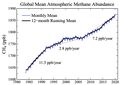 Atmospheric Methane
 -
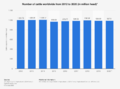 Atmospheric Methane doesn't correlate with cattle population
 -
 Global atmospheric methane has continued rising through 2025
 -
 Annual methane growth rates show the recent acceleration
 -
 Methane rise since 2000


Satellites Put the World’s Biggest Methane Emitters on the Map
NOAA — Trends in Atmospheric Methane, Global CH₄ Monthly Means and Annual Increase
NOAA’s methane trend page provides globally averaged marine surface methane data from its air-sampling network.
The latest page lists February 2026 global CH₄ at 1940.46 ppb, compared with 1933.76 ppb in February 2025, and includes annual growth-rate data through 2025.
NOAA — Globally Averaged Marine Surface Annual Mean Methane Data
| National Oceanic and Atmospheric Administration (NOAA) | Annual Mean CH₄ Dataset | 2026
This raw NOAA dataset gives annual global methane means from 1984 through 2025.
It shows methane rising from 1644.84 ppb in 1984 to 1935.72 ppb in 2025.
NOAA — Globally Averaged Marine Surface Annual Methane Growth Rates
| National Oceanic and Atmospheric Administration (NOAA) | Annual CH₄ Growth-Rate Dataset | 2026
NOAA’s annual growth-rate table shows how quickly atmospheric methane has increased year by year.
Recent high-growth years include 2020, 2021, and 2022, followed by continued growth in 2023, 2024, and 2025.
WMO — Greenhouse Gas Bulletin No. 21
| World Meteorological Organization (WMO) | Greenhouse Gas Bulletin | 2025
WMO reports that globally averaged concentrations of carbon dioxide, methane, and nitrous oxide reached record highs in 2024.
It lists methane at 1942 ± 2 ppb for 2024, using WMO Global Atmosphere Watch observational-network analysis.
IEA — Global Methane Tracker 2026
| International Energy Agency (IEA) | Global Methane Tracker | 2026
The IEA reports no sign that global energy-related methane emissions fell in 2025.
It estimates fossil fuel operations emitted 124 million tonnes of methane per year, with oil, coal, and natural gas all remaining major sources.
IEA — Global Methane Tracker 2026: Mitigation Potential
| International Energy Agency (IEA) | Global Methane Tracker | 2026
The report finds that around 70% of fossil-fuel methane emissions could be abated with existing technology.
More than 35 million tonnes could be avoided at no net cost under 2025 energy prices.
UNEP / CCAC — Global Methane Status Report 2025
This report updates global progress on methane mitigation and the remaining work needed to achieve the Global Methane Pledge.
It finds that methane emissions are still rising, although projected 2030 emissions under current legislation are lower than earlier forecasts.
Global Carbon Project — Global Methane Budget 2024
| Global Carbon Project | Global Methane Budget | 2024
The Global Methane Budget provides a source-and-sink accounting of methane emissions.
The 2024 update focuses on global methane budget changes and helps compare fossil fuel, agriculture, waste, wetland, and other sources.
IPCC AR6 Synthesis Report — Longer Report (Full PDF)
| Intergovernmental Panel on Climate Change (IPCC) | AR6 Synthesis Report | 2023
The comprehensive synthesis of Working Groups I, II, and III findings from the Sixth Assessment Report.
It integrates physical science, impacts, mitigation, and policy-relevant conclusions on climate change including methane’s short-term warming significance.
IPCC AR6 WG1 — Chapter 6: Short-lived Climate Forcers (Methane)
| Intergovernmental Panel on Climate Change (IPCC) | Working Group I Contribution to AR6 | 2021
This chapter assesses short-lived climate forcers such as methane, tropospheric ozone, and aerosols.
It quantifies radiative forcing, atmospheric lifetimes, and methane’s contribution to near-term warming.
IPCC AR6 WG1 — Chapter 6 Supplementary Material
| Intergovernmental Panel on Climate Change (IPCC) | Working Group I Supplementary Material | 2021
Detailed methodological appendices supporting Chapter 6.
It includes uncertainty ranges, model comparisons, emissions metrics, and expanded technical data tables.
UNEP — Global Methane Assessment (2021) (NASA Reprint PDF)
| United Nations Environment Programme (UNEP) | Global Methane Assessment | 2021
A landmark assessment outlining methane sources, mitigation opportunities, and potential temperature reductions.
It emphasizes rapid methane cuts as one of the most effective near-term climate strategies.
UNEP / CCAC — Global Methane Assessment: 2030 Baseline Emissions Report (Full)
| UNEP & Climate and Clean Air Coalition (CCAC) | Baseline Emissions Report | 2022
This detailed baseline report provides methane emissions projections through 2030.
It breaks emissions down by sector (energy, agriculture, waste) and region for mitigation planning.
CCAC / UNEP — Global Methane Status Report 2025
| Climate and Clean Air Coalition (CCAC) & UNEP | Global Methane Status Report | 2025
A status update on methane concentrations, trends, and policy action worldwide.
It evaluates progress, identifies high-emitting sectors, and analyzes mitigation gaps.
IEA — Global Methane Tracker 2025 (Full Report)
| International Energy Agency (IEA) | Global Methane Tracker | 2025
An annual tracking report focused on methane emissions from the energy sector.
It provides satellite observations, country-level data, and cost-effective abatement pathways.
IEA — Global Methane Tracker 2025 (Documentation / Methods)
| International Energy Agency (IEA) | Technical Documentation | 2025
Technical documentation explaining data collection, modeling assumptions, and emissions estimation methodology.
It supports transparency and reproducibility of the Tracker’s findings.
EPA — Methane Emissions in the United States: Sources Overview
| U.S. Environmental Protection Agency (EPA) | Methane Emissions Overview | 2019
A sector-by-sector overview of U.S. methane emissions.
It covers agriculture, natural gas systems, landfills, coal mining, and wastewater sources.
EPA + USDA — Food Waste and Methane: What’s the Connection?
| U.S. EPA & U.S. Department of Agriculture (USDA) | Fact Sheet | 2024
A joint fact sheet explaining how food waste contributes to methane production in landfills.
It outlines waste reduction strategies to reduce emissions.
NOAA — State of the Science Fact Sheet: Methane and Climate
| National Oceanic and Atmospheric Administration (NOAA) | State of the Science Fact Sheet | 2024
A scientific overview describing methane’s atmospheric concentration trends and climate impact.
It summarizes measurement techniques and recent global observations.
NOAA — Methane as a Greenhouse Gas (Methane Cycle Activity)
An educational resource explaining the methane cycle, sources, sinks, and atmospheric chemistry.
It provides accessible diagrams and classroom-ready explanatory material.
IPCC 2006 Guidelines — CH₄ Emissions from Flooded Land (Methods Appendix)
| IPCC National Greenhouse Gas Inventories Programme | 2006 Guidelines (Wetlands) | 2006
A technical appendix outlining methodologies for estimating methane emissions from wetlands and flooded lands.
It forms part of internationally adopted greenhouse gas inventory standards.
GHG Protocol — Global Warming Potential (GWP) Values (AR6 Update)
| Greenhouse Gas Protocol | GWP Values Guidance | 2024
An updated reference table incorporating IPCC AR6 Global Warming Potential values.
It includes methane distinctions (fossil vs. biogenic) and supports corporate and inventory reporting alignment.
Bloombert Green By Naureen S Malik October 21, 2020
GHGSat Inc. released a new methane map on Wednesday that uses data from the company’s two satellites, which were launched earlier this year and can detect methane emitted by oil and gas wells, coal mines, power plants, farms and factories. It’s part of a wave of climate surveillance that will make it possible to hold countries and companies accountable for meeting targets to reduce and eventually eliminate planet-warming pollution.
Methane, explained
BY ALEJANDRA BORUNDA PUBLISHED JANUARY 23, 2019 <embed>https://www.nationalgeographic.com/environment/global-warming/methane/#:~:text=The%20effects%20aren't%20just,be%20attributed%20to%20the%20gas.</embed>
Cows and bogs release methane into the atmosphere, but it's by far mostly human activity that's driving up levels of this destructive greenhouse gas.
 But methane’s chemical shape is remarkably effective at trapping heat, which means that adding just a little more methane to the atmosphere can have big impacts on how much, and how quickly, the planet warms.
Methane is a simple gas, a single carbon atom with four arms of hydrogen atoms. Its time in the atmosphere is relatively fleeting compared to other greenhouse gases like CO2—any given methane molecule, once it’s spewed into the atmosphere, lasts about a decade before it's cycled out. That’s a blip compared to the centuries that a CO2 molecule can last floating above the surface of the planet. But there are many sources of methane, so the atmospheric load is constantly being regenerated—or increased.
